U.S. News
Tuskegee President Stands Firm on Dress Code for Student Success

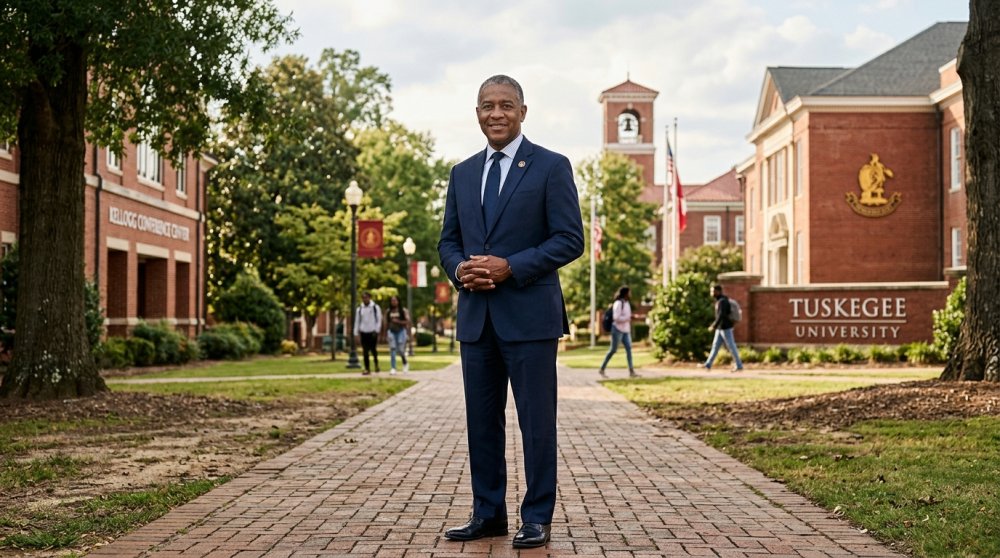
Clear Facts
- Tuskegee University President Dr. Mark Brown, a retired Air Force major general, has reaffirmed the school’s dress code requiring business attire and banning non-religious head coverings like durags and bonnets.
- The policy aims to prepare students for the workplace, with Brown noting that 70% of recent graduates already had jobs lined up.
- The university provides professional clothing through its Golden Tigers Community Closet for students who need assistance.
Tuskegee University is standing by its renewed dress code that requires business suits for professional meetings and proper attire in classrooms.
President Dr. Mark Brown, a retired Air Force major general, says the standards are designed to prepare students for real-world success rather than restrict personal style.
“If you raise the bar, students will reach it,” Brown told Fox News Digital in an interview.
“Why don’t we raise the bar? That’s what I think we ought to do. We’re unapologetic about that part.”
The policy bars non-religious head coverings such as durags and bonnets while requiring business suits and shoes for meetings and professional dress in class.
Brown reported seeing positive results during the first days of the school year when students met the higher expectations.
“I had a wonderful time riding around and walking around the campus on the first and the second day of class,” he said. “The bar was raised and it was being reached.”
“But the same is true as if you lower the bar, or if you go past the mistake and fail to address it: That becomes the standard.”
“And so, you know, we are a university of standards. I believe all of higher education should be a university standards.”
The policy has drawn criticism from groups like the Foundation for Individual Rights in Education over restrictions on certain clothing items associated with Black culture.
Brown maintains that the dress code is part of a broader focus on student success that includes punctuality, attendance, internships, and workplace readiness.
“The focus is how do I make you a professional in whatever space you want to go in?” he said.
“Any higher education institution in the country that’s not focused on student success, no matter what type of university that is, is not focused where they should be.”
“That’s why we exist. That’s exactly why we exist.”
Brown noted that the dress code is not new but is receiving greater emphasis to ensure graduates are prepared with the habits employers expect.
“It’s not the world we wish you were going into, it’s the world you’re going to go into,” Brown said. “It’s not the way that we wish an employer would perceive you. It’s the way the employer will perceive you.”
The debate over whether college is worth the cost has increased pressure on universities to demonstrate that students are being prepared for life after graduation.
“What do you want when you send your son or daughter to college?” Brown said. “What do you expect us to do and what do you expect to happen four or five years from now when they graduate?”
Brown said Tuskegee wants students to leave with more than a grade-point average and a diploma.
“We want them job-ready,” he said.
He pointed to punctuality as one example of a habit that may seem minor in the classroom but carries significant consequences in the workplace.
“Would it be sad for us to allow a student to come to class late, practice that for four to five years, and then find out that no matter how great they were with their 4.0 or 3.8 GPA, it won’t keep them that job?” he said.
Critics have questioned whether the dress code places an added financial burden on students, many of whom are Pell Grant eligible.
Brown said the university is prepared to help through its Golden Tigers Community Closet.
“If a student needs help with that, we’re going to help them,” Brown said. “That’s not going to be the barrier between compliance and getting ready. We’re going to remove that barrier.”
The university also plans to bring in professionals to teach students the details of business attire, including how to button a coat and properly wear a tie.
“I really want us to bear down and double click, to use a common term these days, on the fact that we have to care as much about what happens in school as what happens after school,” he said.
Brown cited recent employment numbers as evidence that the approach is producing results.
“Seven out of every 10,” Brown said. “That is the challenge. That’s what we should be debating.”
Haley Gluhanich of the Foundation for Individual Rights in Education criticized the policy, saying Tuskegee cannot promise broad freedom of expression while enforcing a sweeping dress code.
“Tuskegee can’t promise students broad freedom of expression while enforcing a sweeping dress code that regulates ordinary, non-disruptive expression,” Gluhanich told Fox News Digital in a statement.
“Preparing students for professional life is a legitimate goal, but it does not hinge on requirements about what adults wear to class or lunch.”
Brown pointed to Tuskegee’s history, including the Tuskegee Airmen, as an example of preparing students to demonstrate competence even in a society where prejudice exists.
“My race and my ethnicity would have absolutely nothing to do about it,” Brown said. “That’s not the subject. The subject is social and economic mobility and student success.”
“It’s not that there wasn’t prejudice in the world,” Brown said. “There’s prejudice in the world today. There’s going to be prejudice tomorrow.”
He argued that Tuskegee’s immediate responsibility is preparing its students to succeed amid those realities.
“I’m not discarding the debates,” he said. “The debates are great. I think America is great because we have debate. But that’s not the purpose of the university in this sense.”
“The purpose of a university is, while the debates go on, to be prepared.”
Brown has heard the criticism but has not encountered significant pushback from Tuskegee students.
He also said he has received positive feedback from leaders at other universities.
“This is not unique,” Brown said. “If you go to many universities, they have dress codes, they have these kinds of things. Perhaps we are, at this moment, [placing] a greater emphasis.”
For Brown, the larger question is whether universities view their responsibility to students as ending at graduation.
“If we think the degree ends the relationship, I do not,” Brown said. “I think the relationship and the value of the time here ends down the road, when that student is getting a return on investment.”
“That matters the most for those students who are economically at a disadvantage, who are using education as a springboard to do better,” he concluded.
“Again, every college president, chancellor – I’ve got to believe – wants that for their students.”
“But do we expect them to practice that when they start work? Or isn’t the classroom an extension of that?” he asked. “Isn’t it a laboratory by which you practice these very important skills? I think it is.”
Let us know what you think, please share your thoughts in the comments below.
