Christianity
Young Men Chart Sudden Return to Faith After Decades of Decline

Clear Facts
- Gallup data shows American men ages 18-29 who consider religion “very important” jumped from 28% to 42% between 2023 and 2025—a 14-point swing in just two years
- This represents a 50% proportional increase and reverses nearly 25 years of declining religious interest among young men
- The shift coincides with rising cultural interest in biblical themes, traditional heroism, and meaning-centered content across podcasts, music, and film
A measurable spiritual reversal is underway among America’s young men. New polling data reveal an unprecedented turn toward religious faith that has emerged with remarkable speed and defied decades of contrary trends.
Gallup released numbers in April showing that the share of American men ages 18 to 29 who say religion is “very important to them” jumped from 28% to 42% between 2023 and 2025. That’s a 14-point swing in two years—a 50% proportional increase, and the single largest shift in our lifetime on how young men relate to religion.
This reversal erased a nearly 25-year decline in religious interest in just two years. While the change is statistically unprecedented, cultural observers have been tracking signals of this shift for some time.
The statistical decline of traditional religious participation began in the mid-1990s. The New Atheist movement that followed made a specific wager: Strip away religious beliefs, and civilization will march forward in progress.
By the 2010s, as America entered an era of intense cultural upheaval, it became clear that promised outcome was not materializing. What emerged instead was a “meaning crisis” and a generation of young men experiencing profound hopelessness.
They watched as deaths of despair skyrocketed, institutional trust declined, and civilization descended as Marxist and postmodern ideologies rushed to fill the religious vacuum. They were handed a world stripped of the timeless guiding stories upon which everything good in American culture had been built.
What the data now suggest is that a critical mass of young men have decided this anti-God experiment has run long enough. Young men are choosing a different path.
The early signals appeared across multiple cultural touchpoints. Jordan Peterson sold out theaters lecturing on Bible stories with millions more watching on YouTube, hungry for someone to show them a story that could give their lives meaningful direction.
Tom Holland’s “Dominion” became the book that thoughtful young men discussed, with its thesis that the moral foundations of the modern West—human dignity, universal rights, concern for the downtrodden—is Christianity all the way down, whether we remember it or not. Justin Brierley, who spent 15 years hosting debates between Christians and the New Atheists, began to notice that young men weren’t listening to the New Atheists anymore.
Joe Rogan’s trajectory reflects this broader cultural shift. Not long ago, Rogan sounded like the average American male: bemused by traditional religion and comfortable with the assumption that faith was something smart people had outgrown.
In the last several years, his posture has shifted visibly. Guest after guest, from biblical scholars such as Wesley Huff to Christ-curious comedians, get invited to wrestle seriously with the question of God rather than brush it aside.
In 2025, Rogan himself started attending church. His podcast reaches tens of millions of young men weekly.
Other signs in pop culture hinted at a coming spiritual turn. In late 2023, young men started playing old Creed songs again without irony—songs drenched in sincere, hungry religiosity the 2000s had trained everyone to mock.
In 2024, Creed had its highest-grossing year as a band, propelled primarily by young men who were too young to listen to the band’s religiously tinged albums when they first came out. The popular stories that filled screens began to reflect the ache men had for a positive vision of male heroism rooted in sacrificial love and the pursuit of something bigger than oneself.
They made “Top Gun: Maverick” and “F1” enormous hits—films that refuse the postmodern move of telling audiences the male hero is an oppressive force of the patriarchy. More recently, they embraced “A Knight of the Seven Kingdoms,” a story about an earnest young man who wants, with his whole heart, to be genuinely good.
They cheered for “Project Hail Mary,” whose message is built on a man named Grace laying down his life for the sake of the world. None of these pop culture signposts are as explicitly religious as a Sunday school lesson.
But they share common ground: They show that young men are hungry for hope, meaning, and purpose in their lives. They reflect a shift from the spiritual closedness of the last two decades to a fresh spiritual openness, and a growing appetite for timeless religious themes of virtue, sacrifice, and the quest for a higher purpose.
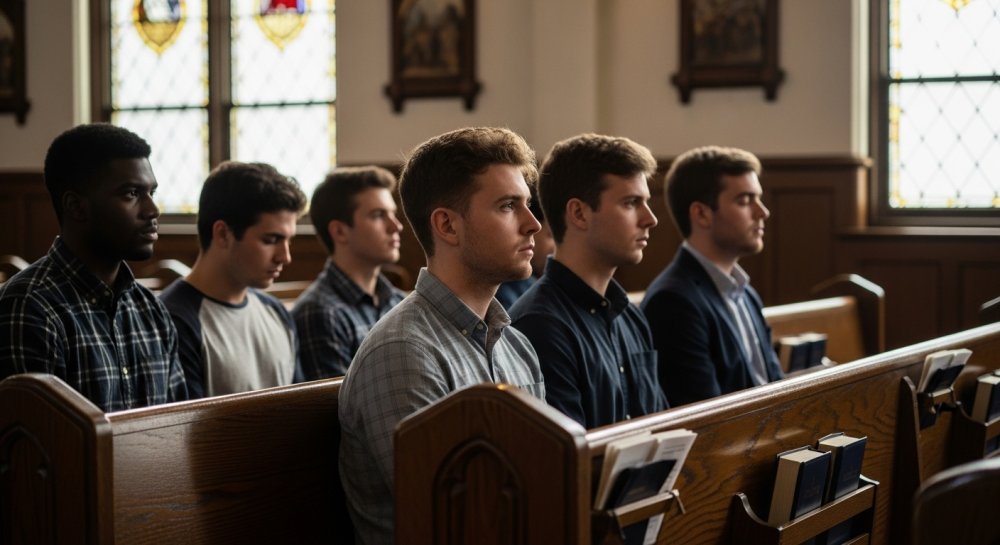
Is this a full-blown religious revival? Young men’s interest in traditional religion has spiked, and some have started to fill the church pews.
What it points to should be encouraging for anyone who cares about the future of America. Young men are increasingly willing, in numbers now measurable, to entertain the possibility that the religious wisdom we had discarded was something we needed.
For 25 years, the trend line pointed in one direction, and even devoted church-going observers assumed it would keep declining. It did not.
In the span of a few short years, a generation of young men looked around at the trajectory of an anti-God culture and, with something like collective intuition, decided they had had enough.
Let us know what you think, please share your thoughts in the comments below.
