Science & Tech
Single Silver Coin Unlocks Secret Location of Doomed Spanish Settlement

Clear Facts
- Chilean archaeologists discovered the exact location of Rey Don Felipe, later called Port Famine, a Spanish colony established in 1584 along the Strait of Magellan that collapsed within three years
- Researchers unearthed a 400-year-old silver coin using metal detection and high-precision geolocation, confirming the site through a ceremonial placement described in historical records
- The settlement was established by King Philip II of Spain to control the critical passage between the Pacific and Atlantic Oceans but was found abandoned with all colonists dead by 1587
Chilean researchers recently announced a breakthrough discovery that solves a centuries-old mystery about one of the most tragic colonial failures in the Americas. Using modern technology and careful historical analysis, archaeologists pinpointed the exact location of Rey Don Felipe — a doomed Spanish settlement that earned the grim nickname “Port Famine.”
The colony was established by King Philip II of Spain in 1584 in Chilean Patagonia along the Strait of Magellan. The strategic location was chosen to control the strait, a critical passage between the Pacific and Atlantic Oceans that represented enormous commercial and military value to the Spanish Empire.
Within three years, however, the site was found abandoned and its colonists dead. The settlement’s collapse was so complete and devastating that it became known as Port Famine, drawing comparisons to England’s Lost Colony of Roanoke.
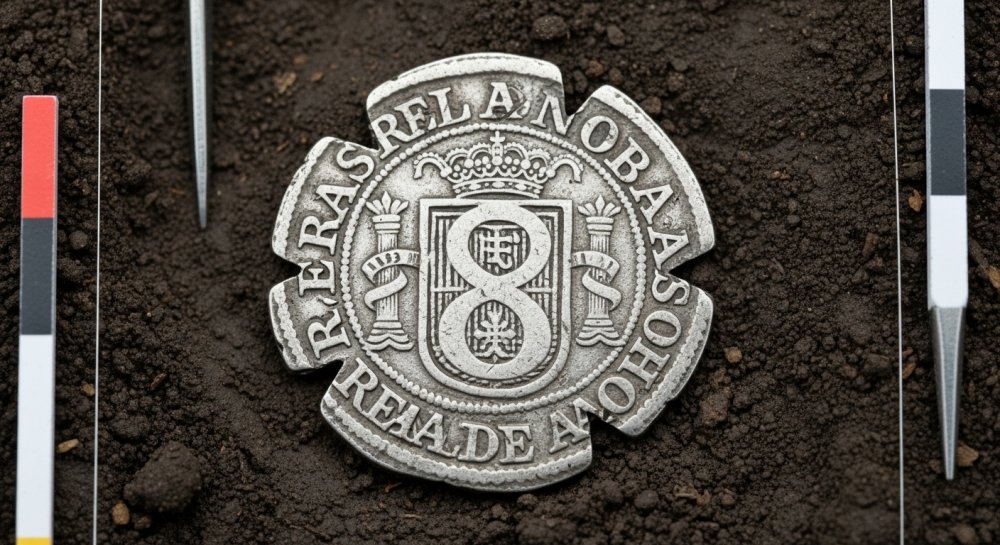
The research team employed metal detection and high-precision geolocation technology, tracking variations in signal strength across the ground to determine where to excavate. Their efforts led them to a single coin — a discovery that confirmed the site’s exact location.
“We initially detected a very strong signal, but we didn’t know what it was,” Francisco Garrido, an archaeologist at Chile’s National Museum of Natural History, said in a press release.
“With the data we gathered, we selected the excavation point — and that’s where we found the coin.”
The silver coin is a real de a ocho, or “piece of eight,” commonly used throughout the Spanish Empire. Pictures of the more than 400-year-old coin show it has an irregular, hand-cut shape, typical of early Spanish colonial minting.
What makes the discovery particularly significant is that the coin was recovered in situ — meaning exactly where it was originally placed. The find was consistent with historical accounts describing a coin placed as part of a founding ritual, a ceremonial practice used by the Spanish monarchy to mark their possession of new territories.
Soledad González Díaz, a researcher at Bernardo O’Higgins University in Santiago, explained the historical importance of the find.
“This demonstrates the importance of returning to already known sites with new questions and tools,” González Díaz told media in a translated statement.
The site was originally discovered in the 1950s but hadn’t been excavated in more than half a century. Since then, historians have uncovered multiple historical documents, including a 16th-century map, while survey and analysis technologies have advanced greatly in precision.
González Díaz noted that the coin indicates “the exact point where the colonizing project was materialized,” referring to the ceremonial placement described in historical records.
“Its discovery not only coincides with documentary descriptions, but it also has deep symbolic value, since it forms part of a foundational rite,” added González Díaz.
“These ceremonies were solemn occasions through which the Spanish monarchy marked its presence and took possession of new territories.”
In their press release, researchers called Port Famine “one of the most tragic and mysterious colonial experiments in the Americas.” They added that the discovery highlights the fragility of early colonial ventures, showing how settlements were shaped by isolation, limited resources, and uncertain support from distant imperial centers.
The researcher hopes that continued excavation will reveal more about why the colony failed and shed light on the lives of the colonists and Indigenous populations in Patagonia.
“The most widespread version of the story of Rey Don Felipe states that the colony failed due to hunger and desolation. While there is some truth to that, the reality was much more complex,” she said.
“What we see instead is a scenario also marked by tensions, conflict and violence — elements that must be incorporated into the analysis in order to understand the failure of the project.”
Despite excavating in a remote environment, González Díaz noted that her team only faced “logistical challenges, nothing impossible to overcome.”
The project has been documented in audiovisual format from the start, and the team is working on a documentary set to be released next year.
“The research began in a very spectacular way. During our first campaign, in 2019, two bronze artillery pieces belonging to the expedition came to light,” she added.
“This finding marked a very strong starting point for the work we have carried out since then.”
Let us know what you think, please share your thoughts in the comments below.
