Politics
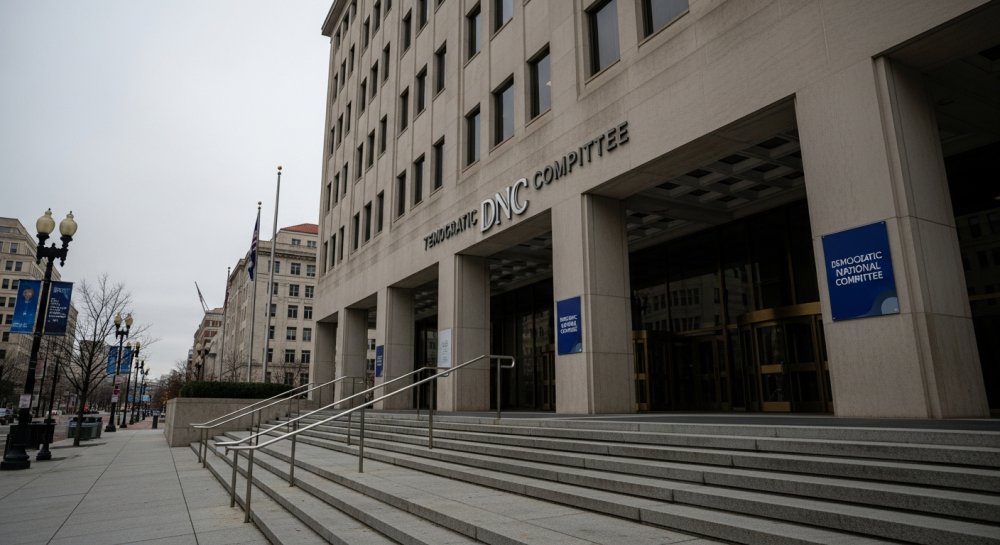
Financial Crisis Threatens Democratic Party Infrastructure as GOP War Chest Swells Past $650 Million

Clear Facts
- The Democratic National Committee ended June with just $16.3 million cash on hand and $18.5 million in debt, while the Republican National Committee holds $128.5 million with zero debt
- Republican Party committees and allied super PACs collectively hold roughly $657 million compared to Democrats’ $334 million, with Trump’s MAGA Inc. adding another $400 million
- A recent Supreme Court ruling in NRSC v. FEC removed limits on coordinated spending between parties and candidates, making institutional fundraising more valuable than ever
The Democratic Party faces an unprecedented financial crisis that threatens its ability to compete in 2026 and beyond. While individual Democratic candidates continue raising impressive sums, the party’s institutional backbone is crumbling under mounting debt and organizational dysfunction.
DNC Chairman Ken Martin’s leadership has come under intense scrutiny as morale plummets within the organization. According to the New York Times, Martin has made dark jokes about losing his job and reportedly threw his phone at a staffer’s desk during a heated exchange that led to a human resources complaint.
The numbers tell a sobering story. Federal Election Commission filings reveal the DNC finished June with a mere $16.3 million in cash while carrying $18.5 million in debt. The situation has become so dire that Democratic officials have privately asked vendors to postpone sending invoices until after the midterm elections, according to reports.
Meanwhile, Republicans are operating from a position of overwhelming financial strength. The RNC boasts $128.5 million in cash with no debt whatsoever. When including all Republican Party committees and allied congressional super PACs, the GOP holds approximately $657 million in available funds—nearly double the Democrats’ $334 million.
The financial advantage grows even more dramatic when factoring in MAGA Inc., President Donald Trump’s allied super PAC, which reported over $400 million available for future spending. This represents a fundamental shift in the balance of political power heading into the crucial 2026 midterm elections.
The Supreme Court’s June ruling in NRSC v. FEC has made this disparity even more consequential. The decision struck down limits on coordinated expenditures between political parties and candidates as a violation of the First Amendment.
“It doesn’t change the money that’s available to party committees. It changes how party committees are able to spend it,” explained Jessica Furst Johnson, partner and co-chair of the political law practice at Lex Politica and counsel for the petitioners in NRSC v. FEC.
This ruling dramatically increases the value of institutional fundraising—precisely where Republicans now hold their most commanding advantage. While Democrats have traditionally relied on wealthy individual donors and candidate-specific fundraising, the new legal landscape rewards parties that can coordinate resources strategically across multiple races.
The irony is that many Democratic candidates themselves are thriving financially. Georgia Sen. Jon Ossoff has built a substantial fundraising lead over Republican challenger Rep. Mike Collins. Former North Carolina Governor Roy Cooper has likewise assembled an impressive war chest for his Senate campaign.
But these individual successes mask a fundamental structural weakness. National party committees exist to recruit candidates, coordinate messaging, direct resources toward vulnerable races, and build unified national political strategies. Without a financially healthy central organization, those critical functions fall increasingly on individual campaigns.
The result is a two-tiered system within the Democratic Party. The “haves” are nationally recognizable candidates who can raise tens of millions independently. The “have-nots” are first-time challengers, vulnerable incumbents, and down-ballot candidates who traditionally depended on party infrastructure to amplify their campaigns.
One longtime Democratic strategist warned that Republicans now possess enough institutional funding to execute “a Cadillac plan everywhere,” while Democrats must increasingly choose which candidates deserve outside investment and which will largely fend for themselves.
“Party committees have incredibly talented staff — very experienced, very strategic, working hard and long hours — and they add a lot to the overall political ecosystem. But if you truly view parties as just bill payers, then it’s no wonder you’re looking at this fundraising disparity,” Furst Johnson said.
For Martin, the crisis may prove terminal. Democratic strategist Eddie Vale recently told The Hill that the DNC chair’s poor fundraising is “hurting the other committees and candidates,” while former Kamala Harris campaign finance chair Rufus Gifford declared there is “no saving Martin’s chairmanship.”
Martin’s critics point to multiple failures beyond fundraising. His handling of the party’s delayed 2024 election autopsy drew widespread criticism after the eventual release contained major omissions and errors. Recent reports also revealed the committee lost roughly $29,000 in an email scam last year—a stunning failure of basic organizational competence.
The broader structural reality now confronting Democrats extends far beyond any single chairman’s tenure. The party retains candidates capable of raising enormous sums, but it increasingly lacks the national organization necessary to convert those isolated successes into coordinated strategy.
After the Supreme Court made party committees substantially more valuable as political vehicles, this institutional weakness may prove far more damaging than any individual candidate’s fundraising challenges. The 2026 midterms will test whether the Democratic Party can survive as a coherent national organization or whether it has devolved into a loose collection of independently wealthy campaigns united only by party label.
Let us know what you think, please share your thoughts in the comments below.
