Politics
Newsom Vows Legal Battle After Supreme Court Backs Trump Election Integrity Order

Clear Facts
- Supreme Court ruled 6-3 to allow Trump administration’s election integrity executive order to proceed while litigation continues
- California Governor Gavin Newsom announced plans to file another lawsuit challenging the order’s restrictions on mail-in voting
- Trump’s order directs federal agencies to create citizenship-based voter lists and instructs USPS to deliver mail ballots only to verified eligible voters
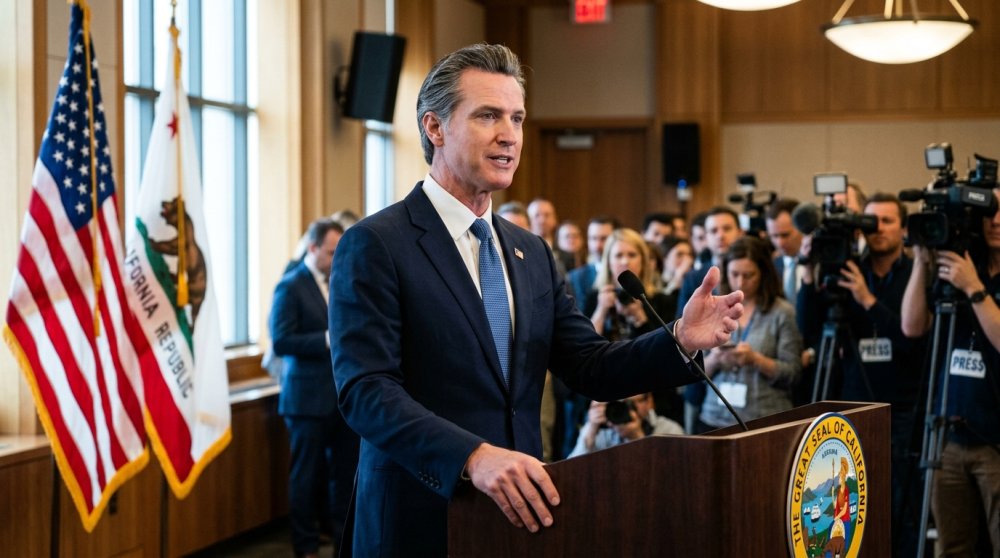
California Governor Gavin Newsom announced plans to sue the Trump administration over its push to restrict mail-in voting after the Supreme Court allowed the administration to enforce challenged provisions of President Donald Trump’s executive order for election integrity while litigation continues. The announcement sets up the next phase of the legal fight after the Supreme Court ruled 6-3 in favor of the Trump administration Monday, lifting an injunction that had blocked the order in 23 states ahead of November’s midterm elections.
The Supreme Court stressed that its decision addressed the injunction rather than the ultimate legality of the order, leaving the door open to additional challenges. Newsom criticized the decision in a statement released by his office.
“The Supreme Court just let the Trump administration move ahead (for now) with its plan to disenfranchise voters across the country,” Newsom said.
“California will be suing AGAIN to block these Orwellian rules from being implemented.”
Newsom’s office also highlighted two election-related bills moving through the California Legislature that the governor says would protect the state’s elections from interference. According to the governor’s office, AB 282 would establish new felonies involving the seizure of ballots, election records or certified voting technology before election results are certified.
SB 259 would establish criminal penalties for interfering with the delivery or return of mail-in ballots, including a felony carrying up to four years in prison in certain cases. The governor’s office described the measures as an “Election Protection” package and said they build on election-related legislation Newsom signed earlier this summer.
The U.S. Postal Service and Department of Justice said they would move to implement the revised mail-ballot restrictions following Monday’s ruling. Trump’s executive order directs federal agencies to compile citizenship-based lists of eligible voters and directs the USPS to deliver mail-in ballots only to people appearing on approved lists.
In explaining its decision, the Supreme Court concluded that the challenged provision directing the Department of Homeland Security to create and distribute state citizenship lists imposed obligations on federal agencies rather than the states themselves. The court wrote:
“[It] directs the Secretary of Homeland Security to take appropriate action to create and distribute State Citizenship Lists. This provision is an internal directive from the President to a subordinate. It imposes no obligations on the States, so they ‘suffer no concrete harm from’ it, and without concrete harm, there is no standing.”
Justices Sonia Sotomayor, Elena Kagan and Ketanji Brown Jackson dissented. The ruling represents a significant victory for election integrity advocates who have long argued that safeguards are necessary to ensure only eligible citizens participate in American elections.
The Trump administration has maintained that the executive order is designed to protect the integrity of federal elections and ensure compliance with existing citizenship requirements for voting. Critics, including Newsom, argue the measures could create barriers to legitimate voter participation.
Let us know what you think, please share your thoughts in the comments below.

Kevin Stich
August 25, 2026 at 6:55 pm
Stupid Newscum SCOTUS has ruled to remove your ability to sue anyone about this
Ima
August 25, 2026 at 7:07 pm
Oh, poor lying, cheating, Scumbucket of course is going to TRY to fight this. Auntie Nanchee’s little brat will never “win” a political race again ~ Not that he LEGALLY won any!!!
Jimmy Brigus
August 26, 2026 at 8:24 am
He should have been an actor. He can deliver lines with a straight face like nobody else on earth. Maybe he actually believes the crap he says? I bet he could convince California the sun isn’t coming up tomorrow, and everyone would buy flashlight batteries. He and pelosi would buy all the battery stocks first!!
April Mahan
August 26, 2026 at 11:38 am
I currently live in California but am relocating out of the hell hole Newsome and his ilk have turned the state into. Having said that, will my ballots continue to go to the address where I’m currently living? I ask because my granddaughter, who moved out of state over 10 years ago, still receives ballots at this address in spite of my efforts to let the county know she is no longer here. I have returned ballots, tried forwarding ballots, called to request they no longer be sent and was told she has to personally request no ballot through a signed notary form. If you have no means of contacting someone, (lost touch), how are you supposed to let them know to do this? I guess the new owners of our house will have 3 extra ballots to use?