Crime
Judge Rejects Defense Request to Remove Holdout Juror in Clancy Trial

Clear Facts
- Judge William Sullivan denied defense attorney Kevin Reddington’s request to remove a lone holdout juror during deliberations in the Lindsay Clancy trial.
- Reddington argued that the judge’s reasonable doubt instructions had been too soft and needed to be delivered more forcefully to the jury.
- Sullivan stated he had followed the instructions as written by the Massachusetts Supreme Judicial Court and could not determine which side of the jury dispute was correct.
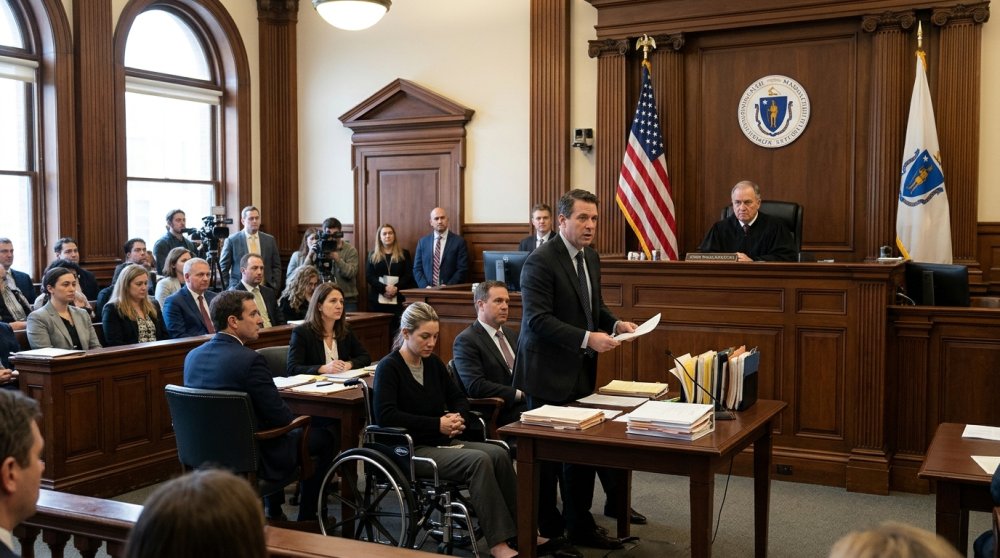
Tensions flared in the courtroom when Judge William Sullivan rejected a defense motion to remove a single juror accused of refusing to follow instructions.
The defense argued that the juror was disregarding the reasonable doubt standard required by law.
“I would ask that you not just give them, as I described it yesterday, a soft inquiry where you listen to my instructions. I would ask that you specifically direct their attention to proof beyond a reasonable doubt and re-instruct them on that forcefully,” Reddington said.
“I think I did that yesterday, didn’t I?” Sullivan snapped back.
“What do you want me to do? Get a brass band? I read the instruction as written by the [Massachusetts Supreme Judicial Court]. The fact that I perhaps didn’t give it my full inflection, I’m sorry about that. I’m not an actor. I’ve just given the instructions,” Sullivan said.
“But just in case the record is clear, I am specifically not glossing over this issue. I have thought about this issue long and hard. I know the defendant objects, but the characterization that I’m glossing over it. Trust me, that’s not the situation,” Sullivan said.
“And I’ll try and give this with more pizzazz than I gave yesterday, I suppose.”
The exchange came after the foreperson sent a note alleging that one juror was refusing to follow the judge’s instructions on reasonable doubt.
Defense attorney Kevin Reddington sought to have the holdout juror replaced with an alternate.
“I don’t feel that it is proper for me to side with one side or the other of the deliberations,” Sullivan said. “I don’t feel it’s appropriate for me to say I agree with one juror or the 11.”
Prosecutor Jennifer Sprague supported the judge’s decision, stating that questioning each juror individually and giving a general instruction on reasonable doubt was appropriate.
“I think what Your Honor has done by asking each juror if they’re able to follow the law and then giving a general instruction on reasonable doubt is appropriate,” she said.
“You should consider all of my instructions as a whole. You may not ignore any instruction and give special attention to any one instruction. You must follow the law as I give it to you, whether you agree with it or not,” Sullivan told the jury.
“I want to remind you that you are required to follow my instructions on the law as I gave them to you,” Sullivan told the jury. “Proof beyond a reasonable doubt does not mean proof beyond all possible doubt.”
Under Massachusetts law, the prosecution must prove beyond a reasonable doubt that the defendant was sane and criminally responsible at the time of the crime when an insanity defense is raised.
“I don’t want a mistrial. Why would I want a mistrial? I kicked the sh*t out of their case,” Reddington told reporters.
Clancy has admitted to strangling her three children inside the family home in Duxbury, Massachusetts.
Her defense team maintains that postpartum psychosis left her unable to understand the wrongfulness of her actions.
The jury is considering verdicts including first-degree murder, second-degree murder, manslaughter, not guilty by reason of insanity, or acquittal.
Let us know what you think, please share your thoughts in the comments below.
