Politics
Judge Blocks Federal Disaster Agency Workforce Reduction Despite Efficiency Push

Clear Facts
- Federal judge ruled Trump administration’s directive to cut FEMA workforce by half unlawful
- Judge found DHS violated 2005 federal law protecting FEMA’s core disaster-response authorities
- Ruling found no evidence of reasoned decision-making behind the planned workforce reduction
- Administration officials allegedly used encrypted Signal app on personal phones to discuss cuts, then deleted messages
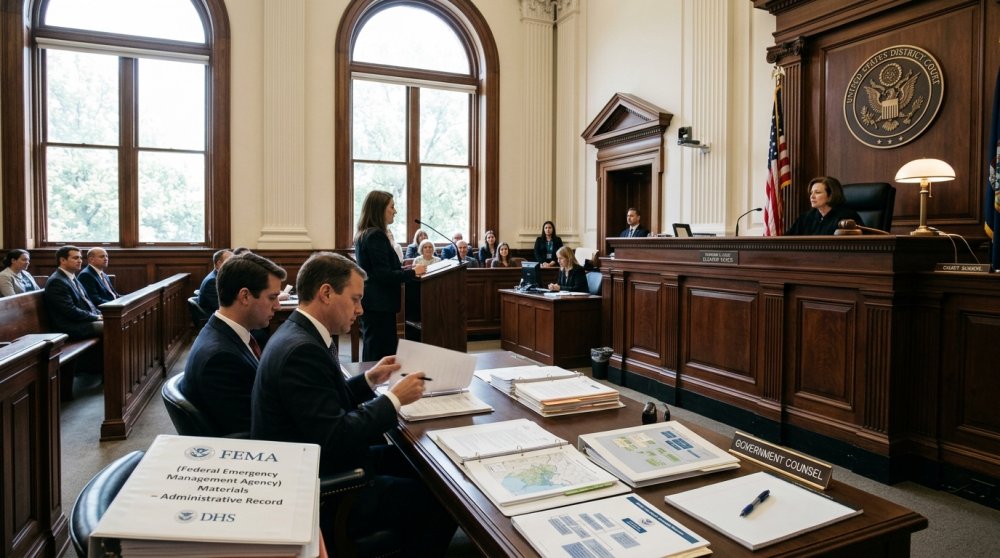
A federal judge has dealt a significant blow to the Trump administration’s efforts to streamline the Federal Emergency Management Agency, ruling that the directive to cut FEMA’s workforce in half violated federal law. U.S. District Judge Susan Illston issued her decision Friday, finding that the Department of Homeland Security overstepped its authority when it attempted to force massive personnel reductions at the disaster-response agency.
The ruling centers on a 2005 federal law enacted after Hurricane Katrina that explicitly protects FEMA from having its “authorities, responsibilities, or functions” substantially reduced by DHS. While FEMA operates under the DHS umbrella, Congress established clear boundaries to preserve the agency’s disaster-response capabilities following the Katrina debacle.
Judge Illston determined that DHS violated this protection last year when it moved to stop FEMA from renewing temporary contracts for thousands of on-call reservists who form the backbone of disaster response operations.
“There is no evidence in the record reflecting reasoned decision-making for this about-face or for the subsequent conditions DHS placed on FEMA’s renewal authority,” Illston wrote.
The judge did not immediately impose remedies or penalties, stating those would be addressed in a separate ruling next month. The parties have until October 9 to submit briefings on what relief remains outstanding in the case.
Labor unions representing FEMA workers filed the lawsuit, arguing the planned cuts would cripple the agency’s core disaster-response mission. Their complaint emphasized that the reductions were not authorized by Congress and were ordered by then-Homeland Security Secretary Kristi Noem rather than FEMA leadership.
The administration has maintained that FEMA possesses considerable flexibility in determining appropriate staffing levels. President Donald Trump has repeatedly questioned FEMA’s effectiveness and suggested the agency should be eliminated entirely, with states assuming responsibility for their own emergency preparedness.
In her Friday ruling, Judge Illston noted that FEMA appeared to be proceeding with workforce reductions despite earlier assurances. She pointed out that FEMA projected staffing levels for the upcoming fiscal year at 11,383 employees—roughly half of previous levels—without providing justification for that specific number.
The judge also issued a separate rebuke regarding evidence destruction. Illston faulted FEMA and DHS officials for using the encrypted Signal messaging app on personal cell phones to discuss the staffing cuts, then deleting those conversations.
The judge said the deleted messages would have been relevant to the lawsuit and declared she would presume the lost communications “would have been unfavorable to Defendants because they would have been further evidence” of unlawful conduct.
A FEMA spokesperson defended the agency’s readiness in a statement, saying:
“Under President Trump and [DHS] Secretary [Markwayne] Mullin’s leadership, DHS and FEMA are ready for the 2026 hurricane season. FEMA continues to maintain a roster of experienced leadership and support staff across headquarters and regional offices. No position is without experienced leadership.”
The case highlights ongoing tensions between the administration’s government efficiency initiatives and congressional mandates protecting essential federal functions. While many Americans support streamlining bloated federal bureaucracy, questions remain about whether disaster response should be a state or federal responsibility—and whether FEMA’s structure serves taxpayers effectively.
DHS and FEMA did not immediately respond to requests for additional comment on the ruling.
Let us know what you think, please share your thoughts in the comments below.
