Politics
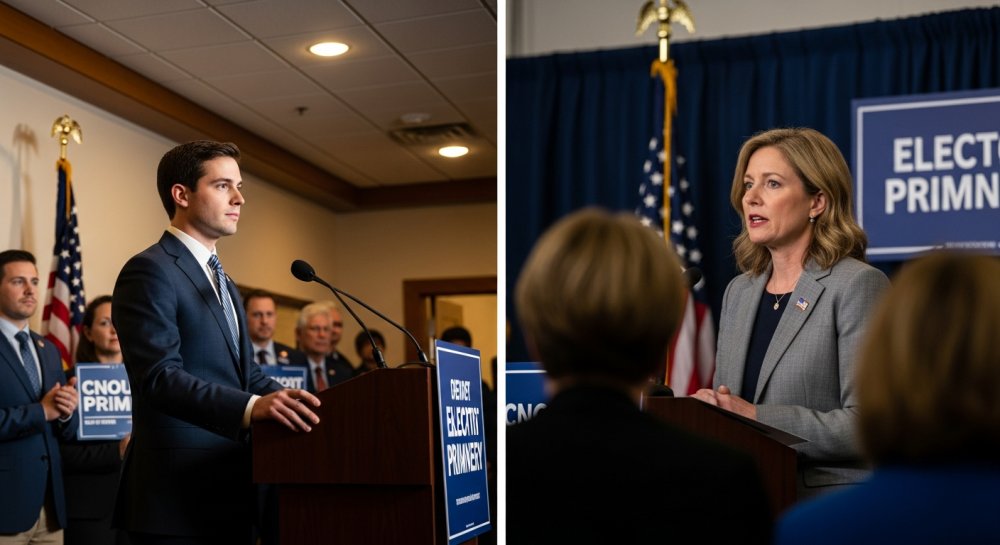
Michigan Senate Primary Exposes Deep Fracture in Democratic Party

Clear Facts
- Progressive candidate Abdul El-Sayed and moderate Rep. Haley Stevens remained locked in a too-close-to-call Democratic Senate primary as of early Wednesday
- Over $80 million was spent on the primary, making it the most expensive Democratic Senate nomination contest in history
- Trump-backed candidates won gubernatorial nominations in Michigan and Kansas, reaffirming the president’s influence within the Republican Party
The Democratic Party’s internal battle between its progressive and establishment wings reached a fever pitch Tuesday night in battleground Michigan. But the anticipated resolution will have to wait.
The Senate primary race between progressive candidate Abdul El-Sayed, a former Wayne County health director, and Rep. Haley Stevens, a more moderate contender, remained too close to call early Wednesday.
“We’re going to have to wait a little longer to see the outcome of this race,” El-Sayed told supporters at a primary night event in Detroit early Wednesday morning.
El-Sayed, backed by Senator Bernie Sanders and Rep. Alexandria Ocasio-Cortez, held a razor-thin lead over Stevens as votes continued to be counted. Stevens received support from establishment figures including Sen. Chuck Schumer, the longtime Senate Democratic leader.
“I know it’s been a long night because that’s the Michigan way. But I want to give you all an update. We knew that this was going to be a close race, and that’s exactly what we’ve got. A close race,” Stevens said.
The race to succeed retiring Democratic Sen. Gary Peters is a must-win contest for Democrats. It stands as one of roughly a dozen Senate races expected to determine whether Republicans retain their narrow majority.
El-Sayed, an epidemiologist who unsuccessfully ran for governor as an insurgent candidate in 2018, would become the nation’s first Muslim senator if elected. He has made support for “Medicare for All” a major component of his campaign.
He has also called for abolishing Immigration and Customs Enforcement. El-Sayed has been a vocal critic of Israel during its war against Hamas, characterizing Israel’s actions in Gaza as “genocide” against Palestinians.
Schumer and other establishment Democrats view Stevens, who flipped a Republican-held district during her first election to Congress in 2018, as more electable than El-Sayed. His past comments have drawn significant controversy.
More than $80 million was spent on the primary, making it the most expensive Democratic Senate nomination contest in history. Much of the money came from outside groups supporting Stevens or opposing El-Sayed. The largest spender was United Democracy Project, a political action committee aligned with the American Israel Public Affairs Committee.
“We all knew that we’re going to spend their money. We didn’t know they were going to spend $70 million of their money. We didn’t know that they were going to outspend us $11 to $1. And yet we’re still standing,” El-Sayed highlighted in his speech.
While the night’s biggest prize remained undecided across five states holding primary elections, Democratic establishment candidates scored several victories. Those included Rep. Wesley Bell of Missouri defeating Democratic Socialists of America-backed challenger and former Rep. Cori Bush, a onetime “Squad” member, in a rematch of their 2024 showdown.
The party’s ideological warfare was front and center in Missouri’s St. Louis-based, heavily Democratic 1st Congressional District. Bell, backed by House Democratic Leader Hakeem Jeffries and other establishment figures, defeated Bush, the former two-term representative whom Bell ousted in the 2024 primary.
Bell was again boosted by a major infusion of outside money, allowing him to substantially outspend Bush and her allies. Much of the funding and advertising targeting Bush came from United Democracy Project, the super PAC aligned with AIPAC.
Bush was among the first House Democrats to accuse Israel of committing genocide against Palestinians during its war against Hamas in Gaza.
“Two years ago, St. Louis voted for better and more accountable representation. We have kept that promise, whether it’s bringing federal resources home to our neighborhoods, standing with working folks when they needed someone in their corner, or helping families cut through red tape,” Bell said following his victory.
Bush lashed out at Bell, criticizing him for skipping candidate forums and claiming he was controlled by billionaires.
“It pisses me off that for the next two years, this community will be represented by someone that didn’t deem you valuable enough to show up to one candidate forum where there were audience comments, even though I showed up to every one,” Bush emphasized.
Back in Michigan, two candidates who are far from left-wingers captured Democratic nominations in statewide contests. Michigan Secretary of State Jocelyn Benson won the Democratic gubernatorial primary in the race to succeed term-limited Gov. Gretchen Whitmer and Attorney General Dana Nessel was renominated.
Meanwhile, President Donald Trump’s powerful sway over the Republican Party was reaffirmed as two Trump-backed candidates won gubernatorial nominations in Michigan and Kansas.
Trump-backed Rep. John James of Michigan, a West Point graduate and two-time Republican Senate nominee, defeated multimillionaire businessman Perry Johnson to capture the party’s gubernatorial nomination. James will face Benson in the race to succeed term-limited Democratic Gov. Gretchen Whitmer.
In Kansas, Trump-endorsed state Senate President Ty Masterson prevailed in a crowded field of Republican gubernatorial contenders. Democratic Gov. Laura Kelly is term-limited, making the race to succeed her a leading pickup opportunity for Republicans.
The progressive-versus-establishment battle also played out in Michigan’s 7th Congressional District, a Republican-controlled swing seat. William Lawrence, a co-founder of the Sunrise Movement climate advocacy group, edged out two more moderate Democrats. Lawrence was backed by Sanders and El-Sayed, as well as several prominent progressive groups. He will face Republican Rep. Tom Barrett in the general election.
The party’s internal battle was also on display in Michigan’s heavily Democratic 13th Congressional District, where the Associated Press had not projected a winner early Wednesday. Rep. Shri Thanedar, who is supported by top House Democratic leaders, was being challenged by state Rep. Donovan McKinney. McKinney was backed by Sanders, El-Sayed and “Squad” members Reps. Ilhan Omar, Ayanna Pressley and Summer Lee.
Let us know what you think, please share your thoughts in the comments below.
