Christianity
Ancient Egyptian Discovery Points to City From Moses Era

Clear Facts
- Egyptian archaeologists discovered a 3,000-year-old sandstone lintel bearing the titles of Ramesses II at Tell Abu Seifi, a fortified site near the Sinai Peninsula
- The inscription refers to the “City of Mesen,” a lost city mentioned in ancient texts along the Horus Military Road connecting Egypt to Canaan
- The site lies along a route scholars have linked to the biblical Exodus path mentioned in the Book of Exodus
Egyptian archaeologists have uncovered compelling evidence of a fortified ancient city that may finally solve one of biblical archaeology’s most enduring mysteries. The discovery, announced by Egypt’s Ministry of Tourism and Antiquities on August 15, centers on Tell Abu Seifi in northeastern Egypt.
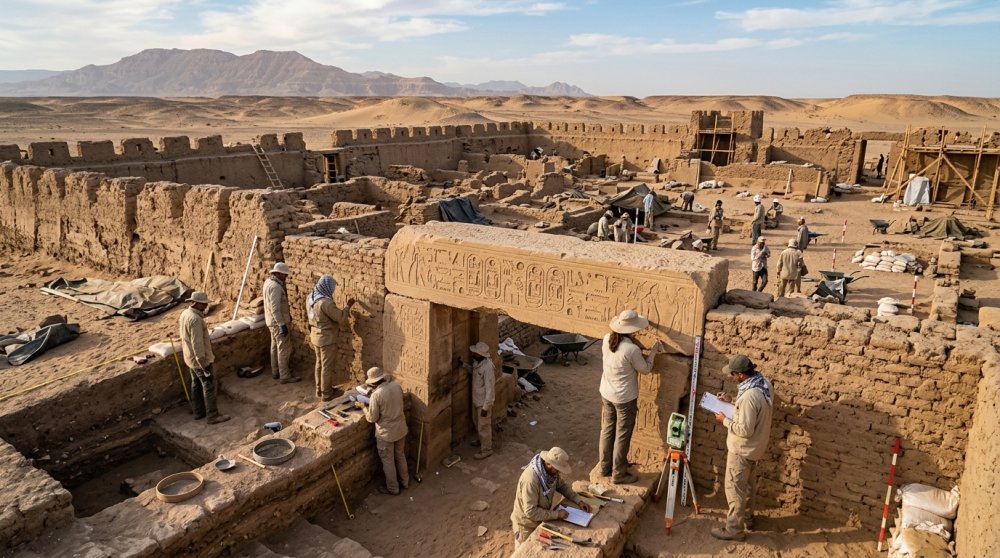
The excavation revealed a massive sandstone lintel more than 3,000 years old, bearing the official titles of Ramesses II, the pharaoh traditionally associated with the time of Moses. The stone beam also contains an inscription referring to the restoration of a statue of Horus, identified as “Lord of the City of Mesen.”
“The discoveries at the site highlight the strategic and cultural role the region played in protecting Egypt’s eastern borders throughout history,” said Minister of Tourism and Antiquities Sherif Fathy.
Tell Abu Seifi once stood along the Horus Military Road, a strategic military route connecting Egypt with Sinai and Canaan. Biblical scholars have long debated whether this ancient thoroughfare corresponds to the “way of the land of the Philistines” mentioned in the Book of Exodus.
According to the biblical account, the Israelites fleeing Egypt under Moses were deliberately led away from this more direct route, despite it offering the shortest path to Canaan. The discovery of a fortified city along this route provides archaeological context for the strategic importance of these ancient passages.
Ramesses II, born around 1303 B.C. and considered one of Egypt’s most powerful rulers, died around 1213 B.C. The newly discovered lintel dates to his reign, placing it squarely in the New Kingdom era when many biblical scholars believe the Exodus occurred.
Beyond the inscribed lintel, archaeologists unearthed the remains of an extensive fortified temple complex. The site includes a mudbrick enclosure wall, gates, storage rooms, and two ancient stone roads leading into the temple proper.
Officials acknowledged that while the evidence “presents a strong archaeological and historical hypothesis linking the site to the ancient Egyptian city of Mesen,” excavation and scientific study continue. Researchers are searching for additional evidence that could definitively confirm the site’s identity.
The settlement’s strategic location near the Sinai Peninsula underscores Egypt’s historical concerns about securing its eastern frontier. The fortification’s scale and design reflect the military importance of controlling access routes between Egypt and the lands to the east.
Archaeological evidence shows the site remained significant long after its initial construction. Parts of the temple complex were converted into a Roman military barracks during the third century A.D., demonstrating the location’s enduring strategic value across civilizations.
Excavators also recovered fragments of falcon statues and other sculptures, providing insight into the religious practices and artistic traditions of the ancient inhabitants. These artifacts will undergo further analysis as researchers work to build a comprehensive picture of life in this border city.
The discovery represents the latest in a series of significant archaeological finds in Egypt this year connected to Ramesses II and the biblical era. Earlier in the spring, archaeologists uncovered a massive statue believed to depict Ramesses II at the Tel Pharaoh site in the Nile Delta.
Shortly after, researchers discovered an ancient settlement at Tell el-Koua in Wadi Tumilat, another region linked to ongoing scholarly debates about the historical setting of the biblical Exodus. These parallel discoveries are providing unprecedented insight into Egypt’s New Kingdom period and its connection to biblical history.
Minister Fathy emphasized that the findings “represent an important addition to the ministry’s efforts to uncover the history of archaeological sites in North Sinai and the Qantara region.” The region’s archaeological potential remains largely untapped, with many sites awaiting systematic excavation.
The inscription’s specific reference to Mesen holds particular significance because the city had been known only from ancient texts until now. Locating the physical site allows archaeologists to corroborate written records with material evidence, a crucial step in confirming historical accounts.
As excavation continues at Tell Abu Seifi, researchers hope to uncover additional inscriptions, artifacts, and architectural features that will either confirm or refine their understanding of the site’s identity and historical importance. The intersection of archaeological evidence and biblical narrative continues to yield valuable insights into the ancient world.
Let us know what you think, please share your thoughts in the comments below.
