U.S. News
Army Slashes Helicopter Funding as Drone Warfare Forces Military Revolution

Clear Facts
- Army’s FY2027 budget cuts Apache helicopter funding from $361.7 million to $1.5 million while ramping up drone and autonomous systems investment
- Service plans to eliminate roughly 6,500 active-duty aviation positions including pilots and crews over the next two fiscal years
- New rapid procurement initiative aims to develop low-cost interceptors to replace multimillion-dollar Patriot missiles for drone defense
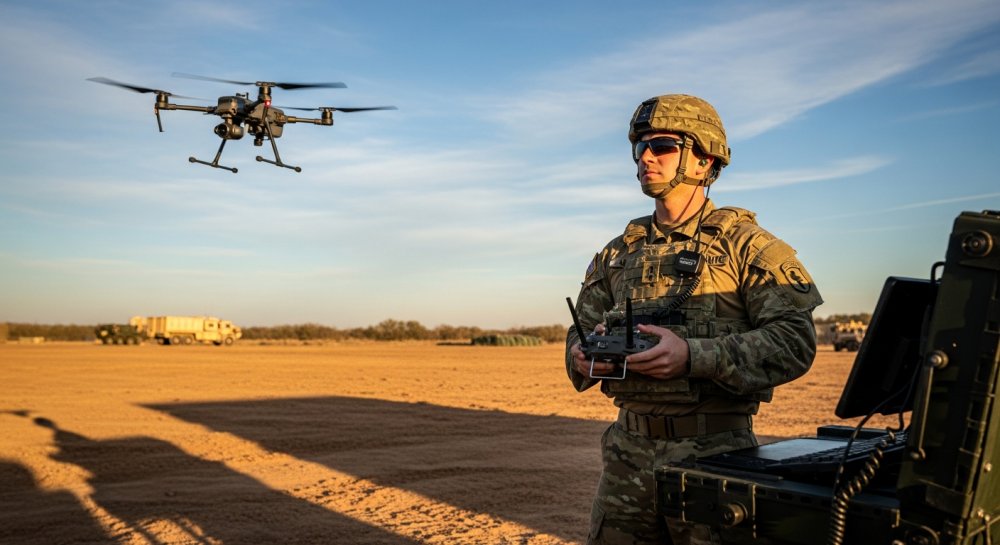
The U.S. Army is executing a dramatic shift away from traditional helicopter warfare and toward drone-heavy combat operations, driven by hard lessons from Ukraine and Middle East conflicts that exposed the vulnerability of expensive manned aircraft in modern battlefields.
Army leaders signaled Wednesday that the transformation is already reshaping procurement priorities and force structure. The fiscal year 2027 budget request slashes funding for America’s premier helicopter platforms while dramatically increasing investment in unmanned systems and low-cost battlefield technologies.
The numbers tell the story: Apache attack helicopter funding drops from roughly $361.7 million to about $1.5 million. Black Hawk procurement falls from approximately $913 million to roughly $39.3 million. Chinook funding decreases from about $629 million to approximately $210 million.
The service previously announced plans to cut roughly 6,500 active-duty aviation positions over fiscal years 2026 and 2027, including pilots, flight crews and maintainers, as resources shift toward unmanned systems and drone warfare.
“Absolutely, as we look across the aviation portfolio … we’re re-looking that,” Assistant Army Secretary Brent Ingraham said during a Pentagon media roundtable Wednesday.
Ingraham explained the Army is reassessing how traditional manned aircraft fit alongside larger unmanned systems increasingly capable of missions once handled by helicopters. The proposed cuts have already drawn concern from members of Congress on both sides of the aisle.
During a recent Senate Armed Services Committee hearing, Sen. Mark Kelly, D-Ariz., warned that the Army’s budget request included “zero H-64 Apaches, zero Chinook Block IIs, and one UH-60 Black Hawk,” arguing the service was divesting critical capabilities before validating replacements.
“Your department’s budget request cuts over $5 billion from the industrial base in the aviation sector alone, effectively shutting down all current Army aviation platforms,” Rep. Rosa DeLauro, D-Conn., pressed War Secretary Pete Hegseth during a House Appropriations hearing.
“How did the department arrive at the conclusion that reducing procurement for these Army aviation platforms strengthens rather than weakens the aviation industrial base?”
Hegseth acknowledged the Pentagon was reconsidering parts of the plan, telling lawmakers the department needed to take “another look” at some aspects of the transformation initiative.
“There are some very good things in the Army Transformation Initiative, and there are some things that we’ve needed to get another look at,” Hegseth said.
The War Secretary emphasized Pentagon leaders were focused on ensuring the Army does not create “aviation capability gaps” as it transitions toward more unmanned systems and next-generation technologies.
Army leaders said the rapid spread of cheap drones is forcing a fundamental rethink of how America buys and fields aircraft, missile defenses and battlefield technology. The concern has become increasingly urgent after the U.S. and its allies burned through large numbers of expensive missile defense interceptors during the Israel-Iran conflict and broader Middle East operations.
“We know we don’t want to continue to use a Patriot missile to shoot down a cheap drone,” Ingraham said. “You’ve got to get on the right side of the cost curve.”
The economic reality is stark: multimillion-dollar defensive systems are being depleted countering cheap drones and missiles, raising serious questions about the long-term sustainability of current defensive strategies.
Officials described a new allied drone and counter-drone procurement marketplace designed to speed foreign military sales and standardize interoperable systems across partner nations. Army Secretary Daniel Driscoll compared the effort to “an Amazon for war.”
The marketplace will become available to roughly 25 U.S. allies and partners worldwide, initially focused on drone and counter-drone systems before potentially expanding to additional capabilities and countries. For now, the platform will only allow allies to buy U.S. capabilities.
The Army is also launching a rapid competition to develop low-cost interceptors designed to counter drones and cruise missiles without exhausting Patriot missile stocks. Ingraham said companies will have roughly 120 days after an upcoming industry event to demonstrate technologies ranging from rocket motors and seekers to fully integrated interceptor concepts.
“Even if you don’t have it all on the ground … bring it,” he said.
The transformation reflects growing Pentagon concern that cheap drones, autonomous systems and mass-produced weapons are rapidly changing the economics and survivability assumptions of modern warfare. Conflicts in Ukraine and the Middle East have exposed serious vulnerabilities in traditional armored and aviation-heavy battlefield concepts.
Army leaders increasingly suggest future wars will rely less on small numbers of expensive manned platforms and more on large quantities of cheaper, networked and rapidly replaceable systems capable of surviving in drone-saturated battlefields.
Driscoll said at the roundtable that the service is attempting to overhaul what leaders view as decades of broken acquisition practices that left the Army too slow to adapt to rapidly changing battlefield conditions.
“How do we dig down deep into the system to change the broken processes that have led to so many bad outcomes over the last 30 years?” Driscoll said.
The Army Secretary was blunt about Congressional confidence in military procurement, stating the service had lost Congress’s trust after decades of acquisition failures and budget overruns.
“The United States Army had in some ways lost Congress’s trust over the last 30 years that we could do big new projects, keep them on time, keep them on budget,” he said.
Driscoll referenced the Army’s now-canceled M10 Booker armored vehicle program as an example of the type of procurement failure leaders are trying to avoid.
“When we go to Congress and say, ‘Hey, trust us to develop a new platform. This one will not turn out like the Booker tank,'” Driscoll said.
The Army Secretary argued the service is already fielding new capabilities on dramatically accelerated timelines more similar to wartime adaptation cycles seen in Ukraine than traditional Pentagon acquisition schedules.
“When Operation Epic Fury kicked off, we were able to on day five go start the process to purchase 13,000 Merops counter-drone interceptors,” Driscoll said. “By day 10, we had contracted for something we had never purchased before. They were starting to flow into theater in the thousands by day 20.”
Army officials said the service is trying to rapidly improve how weapons systems, sensors and battlefield networks communicate with one another after studying Ukraine’s ability to quickly integrate commercial and military technologies during the war.
“The Ukrainians were highlighting to us how their open architecture system allowed information to pass between nearly all of their sensors and radars,” Driscoll said. “That empowered so many things that they could do that we just can’t do yet.”
“At this exact moment at Fort Carson, there are 450 developers and programmers jailbreaking all of our equipment,” he added. “I’m cautiously optimistic within a month from now we will have jailbroken literally hundreds of pieces of equipment.”
Let us know what you think, please share your thoughts in the comments below.

Mrbob
May 23, 2026 at 10:40 am
On budget for army/navy/airforce means allowing contractors to take consumer graded drones paint them green build proprietary software then charge 100k to 900k+ for each one. Citizens get screwed again by the military industrial complex. Meanwhile other countries such as Ukraine are taking cheap consumer grade drones big enough to carry a simple bomb and cost a few hundred each and kicking Russia ass with thousands of them.
So for 1000 of these special screw us in the ass drones we will get to pay some contractor a billion tax payer dollars. I am all for the military but not for the way it’s run now as a cash cow for profit for the people ordering his shit [payoffs] and the people running military contractor type companies [ripoff artist].
Some day when China attacks we will run out of arms due to this mess and have our asses kicked because of out and out stupidity.
Proof? We should be using drones to police Iran’s coastline in the straight of Hormuz. Why cant we? Oh yeah for some reason we don’t have the tech or just refuse to use it. Anything that floats and leaves the coast of Iran should be obliterated by the next passing drone that sees it kamikaze style.
Cheap but bigger consumer grade drones could be doing this job right now…. could be but are not. Why? I’m going to guess no profit in that for the people who source our military equipment. When the subcontractors have it ready… who know when? and each $2000 drone cost $2,000,000 then they will begin but it will be far to late by then. Wars seam to be FOR PROFIT affairs these days. No one seams to care because at every turn everyone involved seams to be dueling for payoffs from congress on down. F’cking pathetic.
~