U.S. News
Revolutionary War Cannons Surface After 240 Years Underwater

Clear Facts
- Nineteen Revolutionary War-era cannons discovered in the Savannah River are now on display at the Savannah History Museum
- The artillery spent nearly 240 years underwater before being found by U.S. Army Corps of Engineers in 2021
- Historians believe the cannons were deliberately sunk in 1779 to block French ships from reclaiming Savannah from British occupation
A remarkable piece of American Revolutionary War history has emerged from the depths of the Savannah River just in time for our nation’s 250th anniversary. Nineteen cannons that spent nearly 240 years underwater are now on public display at the Savannah History Museum in Georgia’s oldest city.
The discovery represents the largest collection of 18th century artillery from a single Revolutionary War naval event ever recovered.
“This is the largest discovery of 18th century artillery from a single Revolutionary War naval event,” said Nora Fleming Lee, CEO of Coastal Heritage Society. “So the discovery is really significant nationwide, not just for Savannah.”
The cannons were accidentally discovered in 2021 when a U.S. Army Corps of Engineers crew was dredging the river to accommodate larger cargo ships. The find would prove to be one of the most significant Revolutionary War archaeological discoveries in recent history.
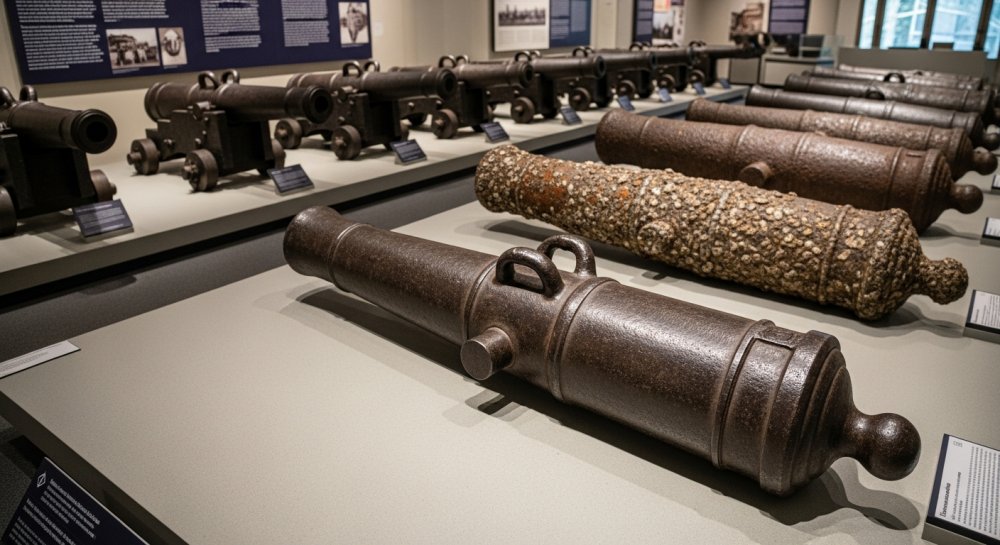
“In total, they brought up 19 cannon and a dozen or so are small artifacts.… They had quite a bit of concretion on them, oyster shells, all kinds of marine life that had attached itself to the cannon,” explained Fleming Lee.
Several of the cannons were found still loaded with cannonballs and gunpowder charges, frozen in time from the moment they sank. After recovery, most of the artillery pieces were transported to a Texas A&M University laboratory for extensive cleaning and preservation work that took several years to complete.
“Running electrical currents essentially through a water bath that they were in, and it desalinates the iron works, so it stabilizes iron to be on land,” said Fleming Lee. “And then in the final treatments, they’re painted with acid and given a spa treatment and waxed and that they can have a very long life here on land.”
Seventeen cannons underwent full restoration. Two were deliberately left untreated to provide visitors with a direct comparison of before and after preservation work.
All 19 pieces are now permanently displayed as part of the new “Loyalists & Liberty: Savannah in the American Revolution” exhibit. The timing couldn’t be more appropriate as our nation prepares to celebrate its 250th anniversary.
Historical research indicates the cannons were deliberately sunk shortly before the 1779 siege of Savannah, when the city was under British control. The strategic scuttling served a critical military purpose.
“We believe these cannons are the last of several ships that were scuttled, at the narrowest part of the Savannah River to act as a blockade for the French fleet to prevent them from sailing up river and reclaiming Savannah for the American side,” said Fleming Lee.
The cannons would have gone to the river bottom just weeks before the Battle of Savannah, one of the Revolutionary War’s bloodiest engagements. Over 800 casualties occurred in less than an hour of fighting on the very ground where the Savannah History Museum stands today.
“The cannons are really the tangible artifacts that are telling the story of revolution,” said Fleming Lee. “And through that lens, we’re expanding Georgia’s revolutionary story. More about the naval events, but more importantly, we’re telling the story through the lens of those who aren’t often focused on.”
The new exhibit presents Savannah’s role in America’s founding through the perspectives of five historical figures representing different segments of colonial society, including indigenous peoples, free and enslaved individuals, women and children. This comprehensive approach ensures future generations understand the full complexity of our nation’s fight for independence.
These recovered cannons serve as powerful reminders of the sacrifice and strategic ingenuity that secured American independence. As we approach our 250th anniversary, artifacts like these connect us directly to the patriots who risked everything to establish the freedoms we enjoy today.
Let us know what you think, please share your thoughts in the comments below.

Buddy Ro
July 5, 2026 at 7:34 am
It’s not clear how the cannons got in the river. Oh, wait, one of the last paragraphs states it’s believed they were on the last ships scuttled. So they didn’t sink cannons, they sank ships with cannons on them. That makes a bit more sense.
Gregg Heil
July 5, 2026 at 10:57 am
So the cannons “surfaced” in the Savannah River? Were they wooden Quaker Guns? Headline writer trying to be funny, or just poor choice of words from someone who uses them for a living?
Oddside
July 5, 2026 at 6:58 pm
Kinda like, new allegations against Trump surface. They just kinda float up from nowhere. But it is the holiday weekend, gotta give the newbies a break. Ya have to start somewhere. Ok , I’m hoarding more of Jim’s ribs. Yum