Crime
Nation’s Capital Sees Homicides Cut in Half Under Federal Intervention

Clear Facts
- Washington, D.C.’s homicide count dropped from 42 to 20 during the same period compared to last year—a nearly 50% reduction
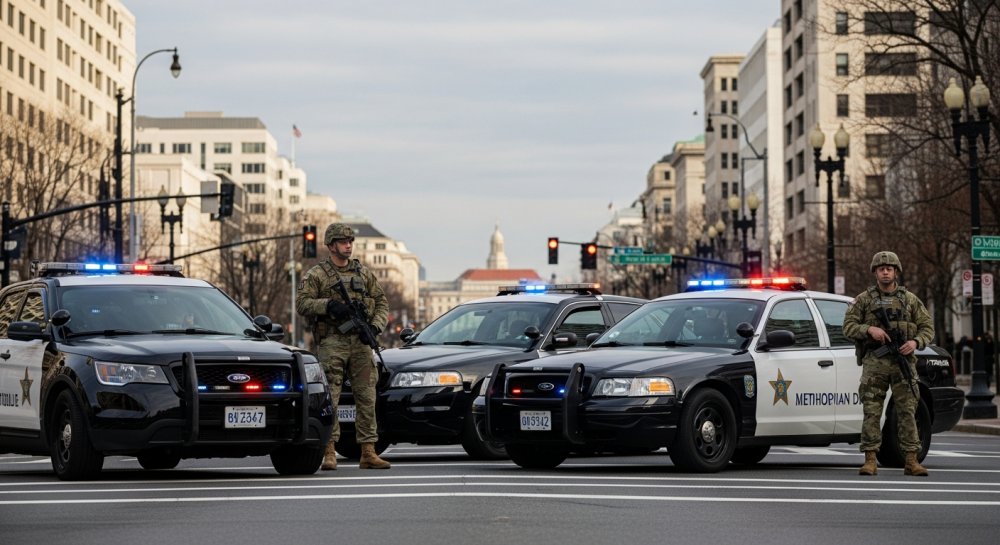
- The Trump administration deployed National Guard troops, federal agents, and appointed U.S. Attorney Jeanine Pirro to combat violent crime in the capital
- Democratic officials who predicted the federal crackdown would worsen crime now face scrutiny as murder rates hit historic lows nationwide
Washington, D.C. has experienced a dramatic turnaround in violent crime, with homicides falling by roughly half compared to the same period last year. The Trump administration points to aggressive federal intervention as the driving force behind the improvement.
There have been 20 murders so far in 2026, compared to 42 during the same timeframe in 2025. The decline coincides with the appointment of U.S. Attorney Jeanine Pirro, a surge of federal agents, and the deployment of National Guard troops to the nation’s capital. The broader national murder rate has reached its lowest point since 1900, which President Donald Trump has credited to his border security policies.
The White House said that Trump’s crime task force has yielded “tremendous results for the community.”
“Crime has dropped across the board, dangerous criminals have been removed from the streets, missing children have been recovered, illegal weapons have been confiscated, and more,” said spokeswoman Abigail Jackson.
She credited the president’s “bold actions in D.C.” for reduced crime and said “residents are thankful.”
However, Thaddeus Johnson, a senior fellow at the Council on Criminal Justice and a criminology professor at Georgia State University, said it is difficult to attribute the decline to any single factor. Johnson noted that Washington, D.C., has struggled with court backlogs and delayed cases in recent years, which may have contributed to higher crime rates.
He said recent progress in clearing the backlog has allowed prosecutions to move forward and taken offenders off the streets.
Johnson acknowledged that aggressive prosecutions by Pirro and others have likely deterred some crime.
“If you’re prosecuting cases, you know that the deterrence is not only the severity of punishment, but it’s the celerity or the swiftness of punishment and the certainty of it — the certainty of punishment is more important than the severity.”
He emphasized that while he is not discounting Pirro or the National Guard deployment, it is difficult to identify any single action as a “magic bullet,” particularly as other cities across the country are also seeing declines. Johnson added that Washington was still grappling with elevated robbery rates as recently as 2024, including incidents occurring outside traditionally high-crime areas in Southeast and shifting into neighborhoods such as the Wharf and Navy Yard.
“I haven’t seen anything per se, evidence directly, where I can say, ‘well, yeah, it’s due to the prosecutions and the judges’ as to why these crimes are going down when we started seeing that many of the crimes had started going down already,” he said.
“It’s hard to say that it didn’t play a part … particularly when we see similar patterns across the nation.”
The White House’s claims of success in reducing crime in Washington contrast sharply with earlier warnings from critics that the National Guard deployment would backfire. District of Columbia at-large councilmember Robert White Jr. warned at the outset that it is abnormal to see armed guardsmen in an American city.
“It’s hard to explain to my kids, who are 6 and 9, what’s happening here. It’s an occupation because it’s both unwelcome and unwarranted. It’s also unhelpful. But I don’t think it’s meant to be helpful in any way.”
The Democrat added local officials “have an obligation to be clear that this is going to make crime worse in the coming years.”
Rep. Jamie Raskin, a Democrat from adjacent Takoma Park, Maryland, similarly predicted the surge was a bad idea.
“No one in Washington is asking Trump to deploy the National Guard or take over the MPD. This is a phony, manufactured crisis if I’ve ever seen one,” Raskin said in August. “Since taking office, Trump has repeatedly undermined public safety in our nation’s capital.”
House Minority Leader Hakeem Jeffries also said last fall that Trump was acting like a “wannabe king” whose “unleash[ing of] the national guard on the city’s youth and homeless population has no basis in law and will put the safety of the people of our nation’s capital in danger.”
Those predictions have not materialized. Instead, the capital has seen a significant reduction in violent crime, raising questions about the Democratic opposition to federal law enforcement intervention.
Let us know what you think, please share your thoughts in the comments below.
