U.S. News
Nuclear Reactor Airlift Marks Rapid Energy Shift

Clear Facts
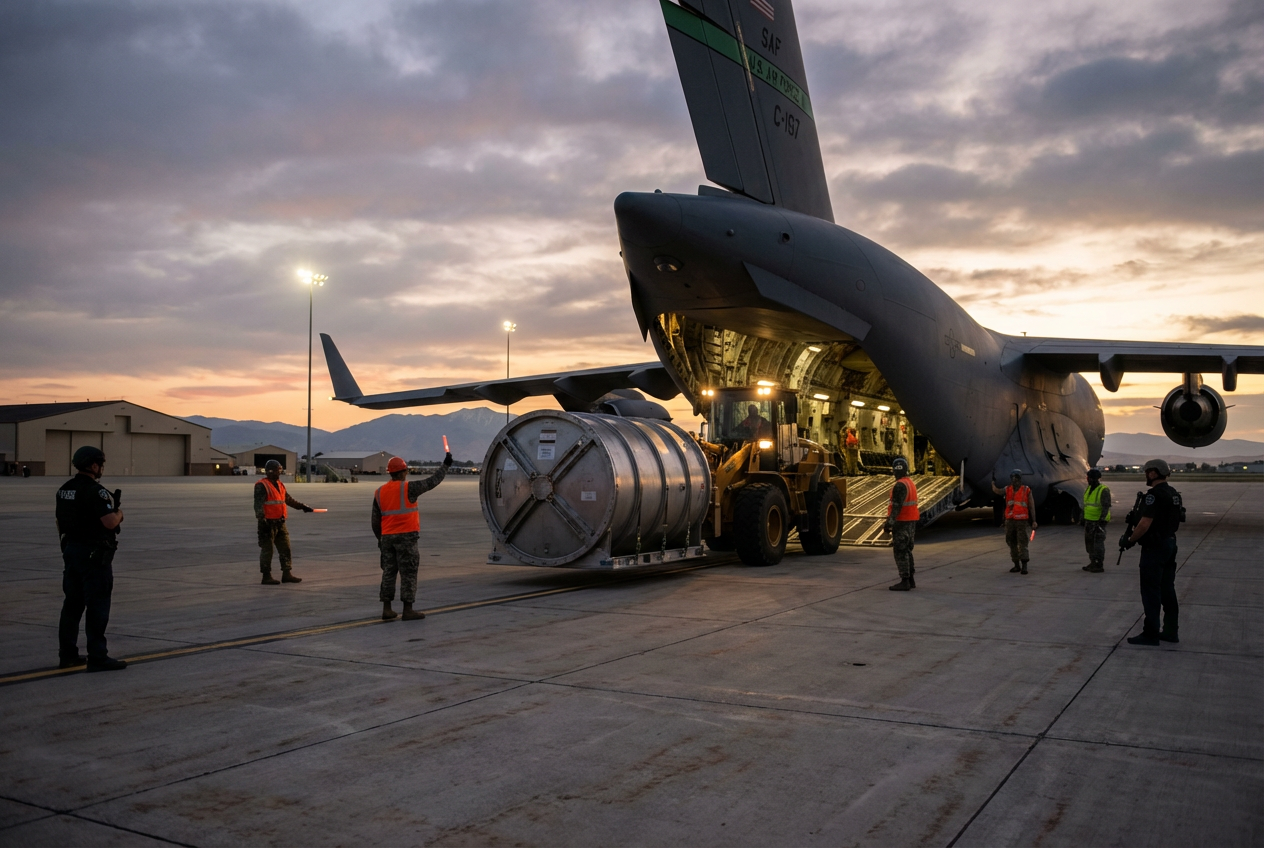
- A C-17 aircraft airlifted a nuclear reactor to Hill Air Force Base in a historic operation.
- The mission, called Operation Windlord, is part of a Department of War, Department of Energy, and Valar Atomics partnership.
- President Trump signed executive orders to boost nuclear energy and streamline regulations for rapid deployment.
For the first time, the U.S. military transported a nuclear reactor by air, demonstrating significant technological advancement and logistics capability. The effort involved three C-17 aircraft moving the Valar Ward250 reactor from California to Utah for future testing.
Operation Windlord is designed as proof-of-concept for quickly bringing reliable power to military operations, as executive orders encourage a stronger, independent energy foundation for national defense.
“I think what we were able to demonstrate today is speed of technology development, speed of the ability to transport,” Under Secretary of War for Acquisition and Sustainment Michael Duffey stated.
The reactor will undergo further testing at Utah’s San Rafael Energy Lab, showcasing potential for military and civilian deployment. Secretary Pete Hegseth’s Acquisition Transformation Strategy aims to modernize and prepare the defense industry for swift action in the face of global threats.
Regulations have slowed nuclear progress for years, but new leadership is focused on overcoming bureaucratic obstacles. Nuclear power is being positioned as crucial for providing secure, uninterrupted energy strong enough to shield against adversary disruption.
“Abundant scalable energy is the foundation of national strength,” said Valar Atomics CEO Isaiah Taylor. “Coal built the industrial age. Oil won the wars of the 20th century. And nuclear energy, deployed at scale, at speed and with American ingenuity, will power the century ahead.”
President Trump’s executive orders direct the Department of War to begin operation of a new nuclear reactor on a domestic base by the end of September 2028. These efforts are intended to usher in a new era of American energy dominance.
Department of Energy Secretary Chris Wright emphasized the urgency. “We went 40 or 50 years without building much in the nuclear space, and from executive orders only about 12 months ago, before July 4 of this year, we will have multiple nuclear reactors critical. That’s speed. That’s innovation. That’s the start of a nuclear renaissance.”
Developing these technologies for the military will enhance America’s civilian power grid, ensuring energy reaches remote towns and industrial centers safely and efficiently.
“Those same technologies that’ll power reactors in remote military operations — they’ll power small towns in Alaska, remote mines in locations, and ultimately, they’ll be coupled together to power data centers and factories,” Wright explained.
The Department of Energy has set the goal for three reactors to reach criticality by the nation’s 250th anniversary on July 4, though this is seen as an ambitious but achievable milestone.
American Energy Institute CEO Jason Isaac clarified that criticality means running in a controlled environment, not full commercial production. “These are controlled learning platforms designed to validate materials, fuel forms, and operational concepts. The safety and authorization standards remain rigorous. If the objective is to build, test, and refine in a controlled environment, that timeline is feasible.”
Isaac affirmed the importance of secure logistics. “When you’re dealing with advanced nuclear hardware on an accelerated timeline, airlift reduces transport risk, compresses schedule uncertainty, and maintains security.”
Nuclear energy is becoming vital to the Pentagon’s use of artificial intelligence and other high-tech advances. Duffey pointed out, “I think we’ll be increasingly dependent on [AI] as a decisive advantage, in both our ability to execute operations, and to manage the huge, you know, mission that the Pentagon has… So, our increasing dependence on AI will therefore have an increasing dependence on not only energy, but resilient energy. And I think nuclear is a really a critical part of it.”
This successful operation marks a concrete step toward energy independence, military readiness, and a renaissance in American innovation.
Let us know what you think, please share your thoughts in the comments below.
