Science & Tech
Untouched 18th-Century Treasure Trove Discovered in Deep Waters

Clear Facts
- An 18th-century shipwreck was discovered 1,970 feet beneath the surface in the Skagerrak Strait off Norway’s southeastern coast, containing the best-preserved cargo of its kind ever found in Northern Europe.
- The wreck contains large quantities of undamaged Chinese porcelain, parts of chandeliers, goblets, bottles, barrels of grain, and crates that may contain textiles, tea, herbs, and medicines.
- A brick from the ship’s galley bears the stamp of Lübecker Ratsziegelei, a German brickworks that operated from the 15th century until 1772, providing crucial clues about the vessel’s origin.
Archaeologists recently uncovered an 18th-century shipwreck in Norwegian waters containing the best-preserved cargo of its kind ever found in Northern Europe. The discovery represents a remarkable underwater time capsule that has remained virtually untouched for centuries.
“The shipwreck’s cargo is unlike anything ever previously found in shipwrecks in Northern Europe,” said Hanna Geiran, director of the Norwegian Directorate for Cultural Heritage.
The organization announced the discovery earlier in June. The shipwreck was found by Espen Saastad, a watch designer who also operates a small remotely operated vehicle and survey company.
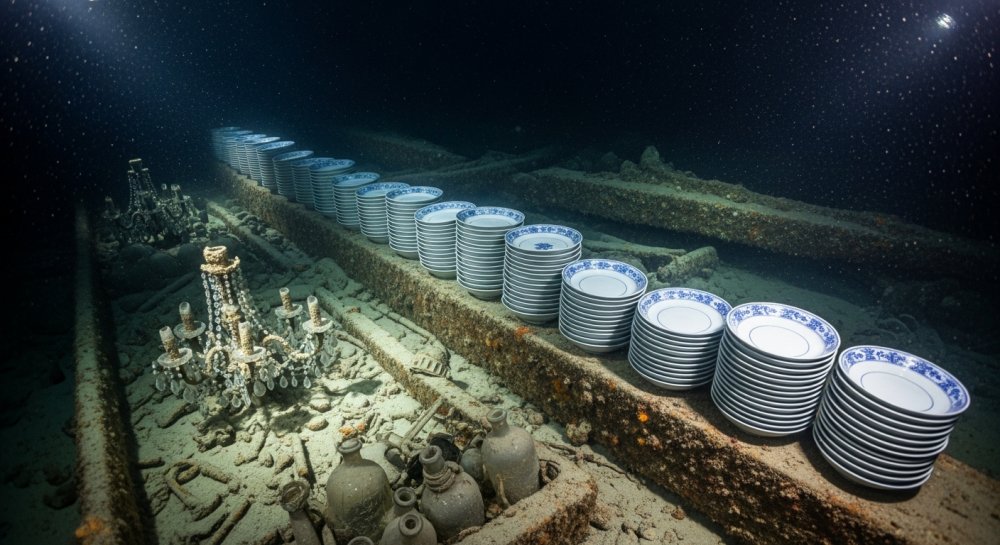
The wreck lies about 1,970 feet beneath the surface in the Skagerrak Strait off Norway’s southeastern coast. Pictures show stacks of porcelain dishes and other artifacts resting on the ocean floor among the ship’s remains.
Geiran told Fox News Digital it’s generally rare to find such well-preserved cargo from 18th-century ships. The discovery offers an unprecedented glimpse into maritime trade during a pivotal period in Western history.
So far, large quantities of undamaged Chinese porcelain have been identified, together with parts of chandeliers, goblets, bottles and barrels of grain. Rows of crates have also been discovered but have not yet been examined.
“One of these appears to contain textiles, while another has a range of organic material, which may include tea, herbs and medicines,” she said.
The cargo is “very well-preserved, considering how old it is,” Geiran added, though modern trawlers have damaged some parts of the wreck. The depth at which the vessel rests has helped protect it from the deterioration that typically affects shallow-water wrecks.
Researchers are still unsure where the ship sailed from or where it was heading, but Geiran said small clues recovered from the wreck may lead them to the answer. Each artifact provides another piece of the historical puzzle.
“Besides the Chinese porcelain, we think that the other luxury goods may have originated in England or Germany,” Geiran said.
“One very interesting clue is a brick from the ship’s galley that bears the stamp of Lübecker Ratsziegelei, a brickworks in Lübeck that was in operation from the 15th century until 1772.”
While researchers cannot estimate the cargo’s original value, Geiran said the porcelain was considered a luxury commodity in the mid-18th century, though it had become increasingly accessible to Europe’s bourgeoisie. The presence of such goods suggests the vessel served the growing merchant class of the era.
Today, she said, the wreck’s greatest value lies in its status as a protected cultural monument rather than its monetary worth. The find represents an invaluable contribution to our understanding of 18th-century commerce and craftsmanship.
Geiran added that researchers are “very excited” about future investigations and whether the wreck still holds additional artifacts. The careful excavation process will take considerable time to ensure nothing is damaged or lost.
“In the pictures from the seabed, for example, we can glimpse a spectacular lotus plant in porcelain,” she said.
“We are also very pleased that this amazing find will be available for everyone to see when it is eventually exhibited at the Norwegian Maritime Museum in Oslo. This is a spectacular find that belongs to the public.”
Let us know what you think, please share your thoughts in the comments below.
