World News
Ancient Faces Emerge After 1,700 Years Buried in Israeli Winepress

Clear Facts
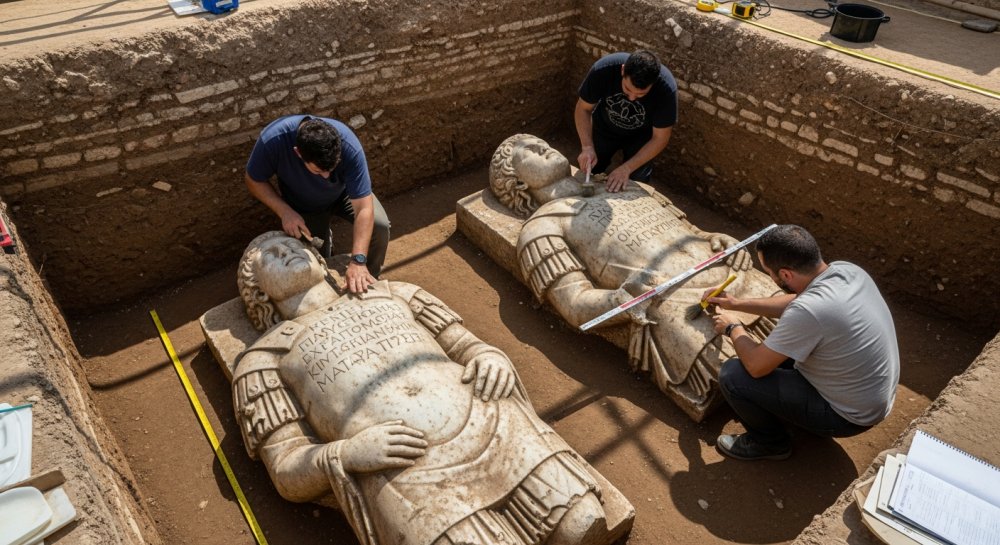
- Two 1,700-year-old Roman-era marble statues were discovered near Binyamina, Israel, during excavation ahead of railway construction
- The statues were found face down in a wine collection pit, appearing to have been intentionally buried when the winepress went out of use
- One statue bears a Greek inscription reading “Lycurgus,” possibly referencing either a Spartan or Athenian historical figure
Archaeologists working near Binyamina, Israel, have uncovered two marble statues that have remained hidden for nearly two millennia. The discovery came during excavation work ahead of construction for a coastal high-speed railway, according to the Israel Antiquities Authority (IAA).
The statues, dating back approximately 1,700 years, were found in the wine collection pit of a Roman-Byzantine winepress. They depict two unknown figures from the ancient Greco-Roman world, with one bearing a Greek inscription identifying the name “Lycurgus.”
Michael Sorotskin, an IAA archaeologist involved in the discovery, described the moment workers made the find.
“While digging the winepress, something was sticking out of the ground, and the workers called me. There was a feeling that we were about to discover something that really shouldn’t be there.”
Sorotskin recalled the excitement as the discovery unfolded.
“Suddenly, we saw that this was not the usual pottery – it was marble. Then, slowly, slowly, the two statues were revealed. I’m still struggling to find the right words.”
The excavation directors, Eliran Oren and Avishag Reiss, noted the unusual positioning of the artifacts. The statues were found “neatly laid, face down,” suggesting they were deliberately buried when the winepress ceased operations.
“At present, it is not known why the statues were hidden here – perhaps to preserve them. This is a once-in-a-lifetime discovery.”
The directors added that major discoveries often come at unexpected moments.
“It was very unexpected, but somehow, the really big discoveries always turn up on the excavation’s very last day.”
Peter Gendelman, a Caesarea region expert from the IAA, called this the first discovery of its kind in roughly three decades. He noted that the “Lycurgus” statue could reference one of two historical figures: Lycurgus of Sparta or Lycurgus of Athens.
“Possibly this statue may prove to be one of these two historical figures, but our research is just beginning.”
According to Gendelman, such statues were typically displayed in public buildings or wealthy residences during the Roman period. These displays served as a way for affluent citizens to “connect themselves to the cultural and spiritual world of antiquity.”
“Not far from the discovery site, remains of a bathhouse were previously uncovered, and it is possible that the statues decorated a luxurious villa of a Caesarea resident.”
Researchers are currently cleaning and conserving the statues before conducting further analysis to determine exactly whom they depict. The discovery adds to a growing list of significant archaeological finds announced by Israeli researchers this year.
In May, IAA officials reported that a child’s chance discovery in the Negev Desert led to the identification of a 1,700-year-old Roman-era statuette fragment. Around the same time, archaeologists uncovered an ancient tunnel near Jerusalem, not far from sites associated with the biblical Kingdom of Judah.
Let us know what you think, please share your thoughts in the comments below.

James Farley
June 27, 2026 at 6:00 am
This is outstanding that these marble statues were discovered after all these years. Thanks for bringing this to our attention. We study Rome & Israel often in our men’s ministry group. I hope more finds like these will be made.
Kathy
June 27, 2026 at 9:28 pm
This is amazing. Thanks for sharing. What do the words mean that are carved on them?