Science & Tech
Ancient Roman Villa With Stunning Mosaic Emerges From British Farmland

Clear Facts
- Archaeologists discovered a 1,600-year-old Roman villa beneath Devon farmland between Halberton and Sampford Peverell
- The fourth-century site features an ornate polychrome mosaic—the westernmost example ever found at a Roman villa in Britain
- Excavators uncovered luxury items including a silver-plated spoon, copper-alloy bracelet, and engraved gemstone depicting the goddess Victory
A remarkable piece of Britain’s ancient past has emerged from centuries of obscurity. Archaeologists working in Devon have uncovered a sprawling Roman villa dating back more than 1,600 years, complete with intricate mosaics and signs of considerable wealth.
The fourth-century estate was found on farmland between the villages of Halberton and Sampford Peverell. The excavation was conducted by the Saving Halberton’s Ancient Roman Environment (SHARE) project, a partnership between the University of Exeter and Cotswold Archaeology.
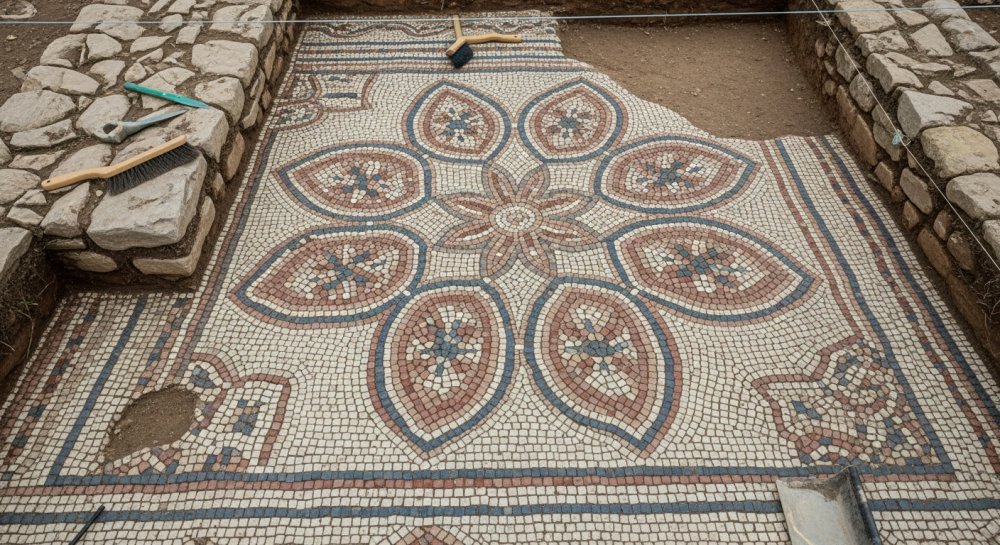
The centerpiece of the discovery is a stunning Roman mosaic crafted from thousands of tiny stone cubes arranged in an elaborate floral pattern. Red, white, and dark blue cubes form a stylized flower with eight overlapping petals—a testament to the artistry and sophistication of Roman Britain.
“The polychrome mosaic is the most westerly example to have been found in a villa in Roman Britain,” said Bill Horner, county archaeologist and historic environment manager at Devon County Council.
“This, and the other trappings of Roman civilization and evidence of affluence that have been found, show how much even this far-flung part of the province had been integrated into the Roman Empire.”
The site includes two additional stone buildings. One is believed to have been a bathhouse, while the other was likely used for agricultural purposes. The presence of such structures indicates this was no modest homestead—it was a center of Roman life and prosperity.
Among the artifacts recovered were a delicate copper-alloy bracelet, a fine silver-plated spoon, and a beaker used for serving drinks. Archaeologists also found pottery fragments and an engraved gemstone depicting the goddess Victory—further evidence of the residents’ status and connection to Roman culture.
Britain was part of the Roman Empire from A.D. 43 until the early fifth century. During that time, Roman influence spread throughout the island, bringing with it architectural innovations, luxury goods, and cultural practices that shaped the region for centuries.
Project leader Susan Greaney, an archaeology professor at the University of Exeter, expressed surprise at the scale of the findings.
“At the outset, we knew this villa, and its surrounding working areas, was an important site for understanding the Romanization of Devon. But from day one, it has offered us a wealth of interesting and sometimes surprising finds in addition to this striking polychrome mosaic. This villa was undoubtedly home to people of wealth and high standing.”
“We did not expect to find such an elaborate bathhouse.”
The site first came to light in 2004, when local metal detectorist John Hill discovered Roman remains in the area. It has taken nearly two decades for the full scope of the discovery to be revealed through careful excavation and analysis.
Officials are now working to carefully transport the mosaic to the Tiverton Museum of Mid-Devon Life, where it will be preserved and displayed for the public. The delicate process will ensure that this remarkable piece of history can be appreciated by future generations.
This discovery is part of a broader pattern of Roman finds across England in recent years. Last summer, archaeologists uncovered an extensive 2,000-year-old Roman settlement in the Cotswolds following an amateur metal detectorist’s chance discovery. This summer, work ahead of a British railway project unearthed a rare Roman coin and additional ancient artifacts.
Each discovery adds to our understanding of how deeply Roman culture penetrated Britain and how much of that legacy remains hidden beneath our feet. The Devon villa stands as a reminder that even in the farthest reaches of the empire, Roman civilization flourished with sophistication and style.
Let us know what you think, please share your thoughts in the comments below.
