World News
Frozen Iranian Funds Could Derail Trump’s Nuclear Framework Before It Begins

Clear Facts
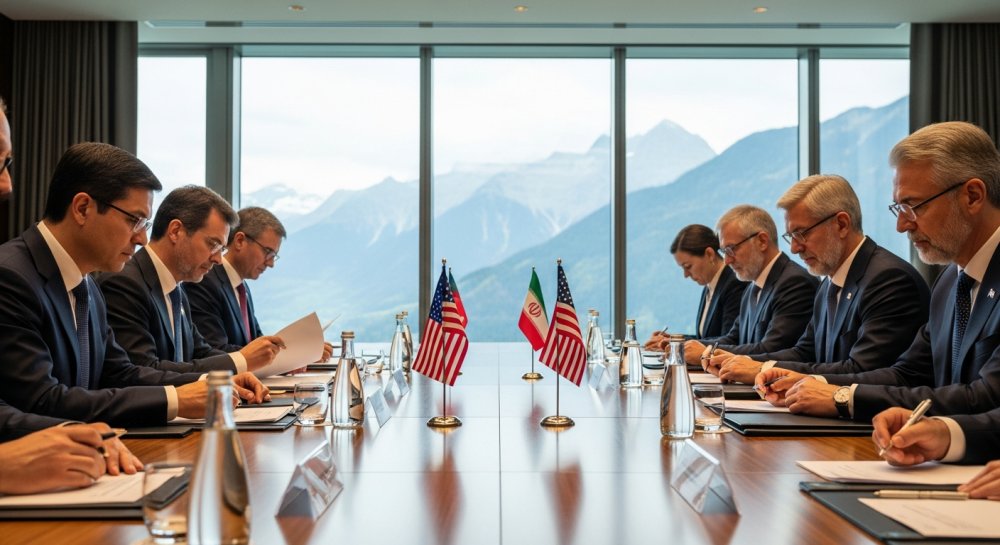
- U.S. and Iranian negotiators met in Switzerland Sunday to implement the June 17 memorandum of understanding, with a major dispute emerging over billions in frozen Iranian assets
- Iran claims over $100 billion in frozen funds abroad, while negotiators focus on releasing an initial $24-25 billion tranche tied to strict compliance conditions
- President Trump stressed Iran would receive “not ten cents” during the 60-day negotiation period if commitments are violated, while Western intelligence warns funds could be diverted to terrorist proxies like Hezbollah
As U.S. and Iranian negotiators convened in Switzerland on Sunday, regional analysts are raising red flags about a fundamental dispute that could undermine President Trump’s interim nuclear framework before it’s fully implemented. The disagreement centers on billions in frozen Iranian assets and how—or whether—those funds should be released to Tehran.
The first round of talks took place at Bürgenstock, near Lucerne, Switzerland, following the memorandum of understanding signed June 17. But already, competing narratives about frozen funds are threatening the fragile agreement.
Iranian President Masoud Pezeshkian signaled Tehran’s expectations early Sunday, claiming victory over the Trump administration.
“$6 billion of our funds in Qatar will be returned. Trump, who tried to deny Iran its rights, acknowledged them in his recent speech,” Pezeshkian said according to Iran International.
The dispute traces back to discussions at the G7 summit in Évian-les-Bains, France, where world leaders debated how to handle Iranian assets frozen under sanctions.
“We have taken their money, it isn’t our money, it is their money, and we froze it,” President Trump said. “At a certain point in time, I guess we’re going to have to give it back.”
But Trump made clear that any access remains strictly conditional. He wrote on Truth Social that Iran would receive “not ten cents” during the 60-day negotiation period if it failed to uphold its commitments—a message aimed squarely at ensuring Tehran doesn’t pocket American concessions without delivering results.
“There are effectively two competing narratives about the frozen funds,” Alex Vatanka, a senior fellow at the Middle East Institute, told Fox News Digital. “Releasing frozen assets is not simply an economic question.
It is one of the central political tests of trust between Tehran and Washington and will likely become one of the first major implementation disputes in the weeks ahead.”
Paragraph 11 of the MOU framework states that the United States “undertakes to make fully available” restricted and frozen Iranian funds. However, the agreement ties any release to a step-by-step process based on compliance, rather than granting immediate, unrestricted access—a critical safeguard against Iranian bad faith.
“First, there remains considerable uncertainty over the total amount of Iranian assets frozen abroad,” Vatanka said. “Iranian officials often speak of more than $100 billion, while Western estimates range higher.
The immediate negotiations, however, appear focused on securing access to roughly $24 billion to $25 billion as an initial tranche.”
Iran’s frozen assets are widely estimated at between $100 billion and $120 billion, held under sanctions and financial restrictions in countries including China, India, Iraq and South Korea. These funds represent oil revenues and other assets that have been inaccessible to Tehran due to international sanctions stemming from its nuclear program and support for terrorism.
Vatanka said the central dispute extends beyond the size of the payout.
“The real dispute is not simply about how much money Iran receives, but who ultimately controls how it is spent. Iranian officials are emphasizing sovereignty over the funds, while the United States is trying to preserve leverage by attaching conditions to their use,” he added as talks got underway Sunday.
In a statement on X, Qatar’s Foreign Ministry said the talks are aimed at reaching a comprehensive and lasting agreement covering all elements of the framework. Spokesman Majed bin Mohammed Al Ansari said technical teams were negotiating the final deal while oversight groups would monitor implementation and track progress.
The U.S. and Qatar are exploring a mechanism to channel an initial $6 billion toward humanitarian purchases, including food and medicine. But the devil remains in the details—and Western intelligence officials have serious concerns about where this money could actually end up.
Western intelligence officials remain concerned that unfrozen funds could be diverted to regional conflicts rather than domestic development projects. This isn’t paranoia—it’s based on Iran’s well-documented history of funding terrorist organizations across the Middle East.
Reports indicate that Iran has already signaled to Hezbollah that increased financial support could resume if Tehran’s cash flow improves—a troubling preview of how these funds might be misused.
“This issue also has an important regional dimension,” Vatanka said. “Iran has pledged to direct a portion of those reconstruction funds toward supporting its weakened proxy network in Lebanon.”
“The United States has insisted that Iran cannot use any unfrozen assets to fund terrorist organizations, warning that access to the funds would be revoked if Tehran violates the terms of the agreement,” he added.
This represents a critical difference from previous Democratic administrations that released billions to Iran with minimal accountability. President Trump’s framework maintains leverage by conditioning every dollar on Iranian compliance—a far cry from the Obama-era approach that sent pallets of cash to Tehran with few strings attached.
Vatanka said the two sides also remain divided over the broader purpose of the agreement.
“Tehran is presenting the roughly $25 billion as money that will be released gradually and invested in rebuilding the country’s infrastructure, with officials talking about roads, airports, transport corridors and projects that visibly benefit ordinary Iranians,” Vatanka said.
“Washington, however, appears to be describing something much narrower. U.S. officials have indicated they want the funds released through controlled mechanisms, primarily for humanitarian and other approved civilian purchases, rather than giving Tehran unrestricted access.”
The fundamental question is whether the Trump administration can maintain the pressure that brought Iran to the negotiating table while ensuring that any concessions don’t empower the regime’s worst behavior. The coming weeks will reveal whether this framework can deliver results or whether Tehran will once again exploit American goodwill to fund its destabilizing activities across the Middle East.
Let us know what you think, please share your thoughts in the comments below.
