Science & Tech
Scientists Honored for Research You Won’t Believe Is Real

Clear Facts
- The satirical Ig Nobel awards honored researchers for unusual but legitimate scientific studies including cockroach milk, snake-stepping experiments, and the evolutionary history of kissing
- The ceremony moved outside the U.S. for the first time in its 33-year history due to visa concerns for international honorees
- One winning study found upper-class individuals were more likely to engage in unethical behavior, including stealing candy from babies
A group of scientists received recognition this week for some of the most peculiar research you’ll ever hear about. The Ig Nobel ceremony, which celebrates unusual but genuine scientific studies, took place in Zurich Thursday and was presented by the digital magazine, the Annals of Improbable Research.
The awards, founded in 1991, moved outside American borders for the first time this year. Organizers expressed concern that international honorees might face difficulties obtaining U.S. visas.
Among the winners were researchers who studied cockroach milk, the evolutionary origins of kissing, and a team that tested soil health using buried underwear. Other honorees included scientists who gently stepped on snakes to determine what triggers biting behavior, and those who developed proper nose-blowing techniques.
One particularly eye-opening study found that wealthy, upper-class individuals were more prone to unethical conduct.
“The general pattern seems to be that, with wealth and rising power, you become less engaged with the needs of others and less burdened by the needs of social relationships,” Dr. Paul Piff, a social psychologist at the University of California, Irvine said.
“Taking candy from children might be the least of our worries, but it’s emblematic of the tendency to prioritize one’s own needs over those of others.”
Additional research honored included studies on the power of having mutual enemies, attempts at creating a splash-free urinal, using dead mosquitos for 3D printing, and findings that parents love the smell of their newborn babies but not their teenage children. The science behind parenthood, apparently, has its limits.
For those curious about the kissing study, researchers defined the practice as “a non-agonistic interaction involving directed, intraspecific, oral-oral contact with some movement of the lips/mouthparts and no food transfer.” Romance truly is alive in the laboratory.
“Next time you kiss someone, you can think, ‘This is a 21.5 million-year-old tradition that I’m honoring here,” evolutionary biologist Matilda Brindle of the University of Oxford said.
“It’s not just a modern human behavior. It’s really ancestral.’ And to us, that suggests that it probably has quite a useful evolutionary function.”
Brindle’s team believes that Neanderthals not only kissed each other but may have also kissed early humans. The research suggests intimate behavior crossed species lines in our distant past.
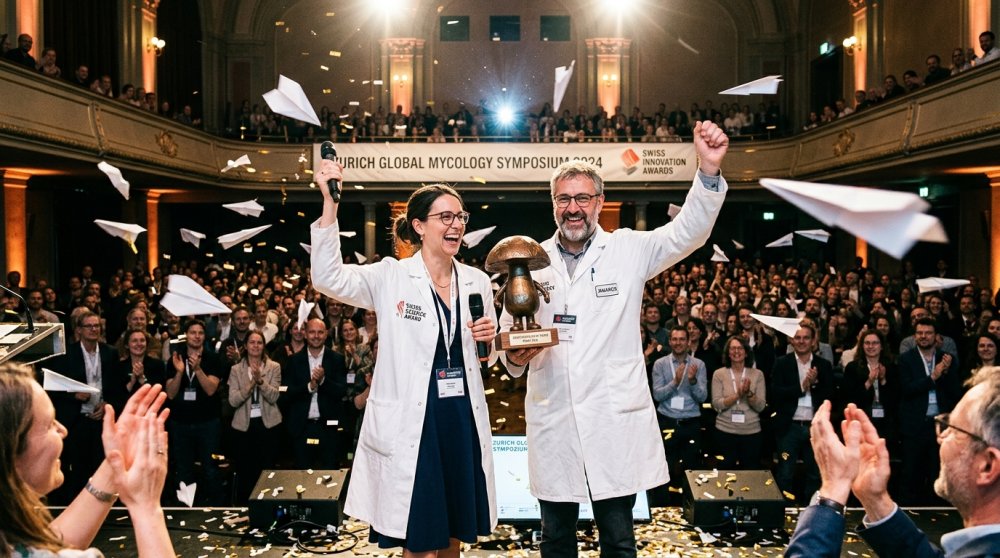
All honorees receive a trophy resembling a cross between a mushroom and a human foot. During the ceremony, audience members throw paper airplanes at the recipients—a tradition as quirky as the research being celebrated.
The Ig Nobel has no relation to the actual Nobel Prize, which will announce its honorees in October. While the real Nobel recognizes groundbreaking achievements that change our world, the Ig Nobel reminds us that science can also be wonderfully weird.
Let us know what you think, please share your thoughts in the comments below.
