U.S. News
Buried Treasury Secrets From America’s Revolution Uncovered in Pennsylvania

Clear Facts
- Archaeologists and college students discovered Revolutionary War artifacts in Newtown, Pennsylvania, including British gunflints, colonial coins, and the foundation of an 18th-century treasury building.
- The site was robbed by the Doan Gang in 1781, just three days after the British surrendered at Yorktown, with thieves stealing 1,200 Spanish dollars and 400 French crowns.
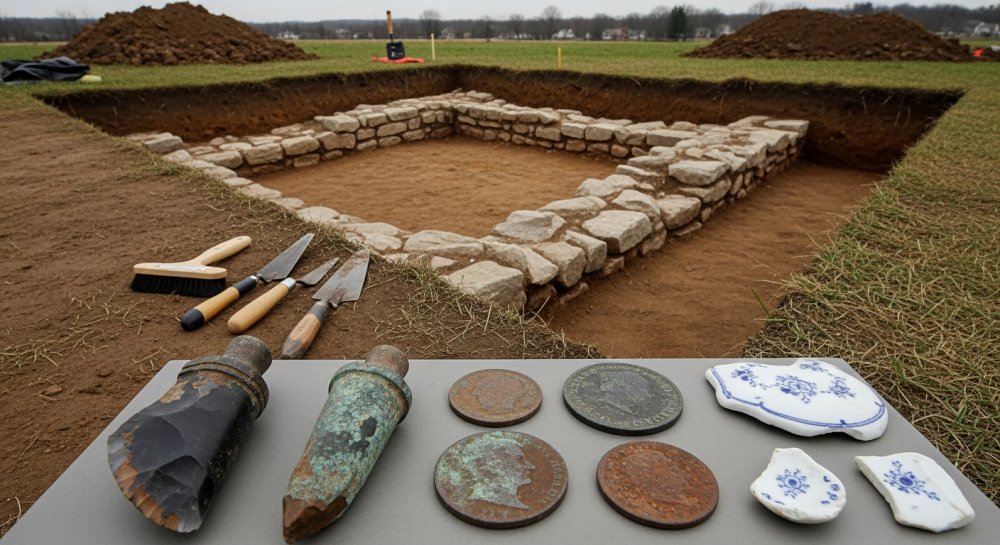
- The excavation uncovered gunflints used in Revolutionary War muskets, a Dutch copper coin, a 1737 New York penny, and over 200 years of preserved porcelain and pottery.
In this year of America’s 250th anniversary, archaeologists and students from Bucks County Community College have unearthed a remarkable piece of Revolutionary War history. The excavation took place in Newtown, Pennsylvania, approximately 30 miles northeast of Philadelphia, revealing artifacts that tell the story of America’s founding struggle.
The dig, conducted from March 23 to March 28, focused on land that once housed colonial-era town buildings, including the county prison and courthouse. What appears today as an unassuming suburban plot was once a crucial site in America’s fight for independence.
Students worked alongside employees from the Mercer Museum to carefully excavate the area where the treasury building once stood. The excavation centered on a location steeped in Revolutionary War history and connected to one of the era’s most audacious crimes.
Clint Flack, an exhibit specialist at Bucks County Historical Society who participated in the excavation, identified the most significant discoveries. The team found three British gunflints from the Revolutionary War era, which were used to spark gunpowder in muskets during battle.
Additional finds included a small set of keys likely used for furniture or padlocks, a Dutch copper coin called a duit, and a New York penny dated 1737. Excavators also uncovered a substantial collection of porcelain, pottery, and glass that had remained beneath the soil for over two centuries.
The team was “very surprised” to discover the treasury’s foundation just below the surface, according to Flack. He described the foundation as being in remarkably good condition despite its age.
The foundation proved to be a critical historical find. This building was the site of an infamous 1781 robbery committed by the Doan Gang, a group of Quaker Loyalists who betrayed the Revolutionary cause.
The robbery occurred just three days after the British surrendered at Yorktown. The gang, primarily composed of members of the Doan family, stole a considerable sum from the Bucks County treasury—1,200 silver Spanish dollars and 400 silver French crowns, along with additional cash.
“The robbery began at the home of county treasurer, John Hart, where the gang seized a bundle of cash that had not yet been deposited in the treasury as well as the keys to the treasury,” Flack explained.
The historian detailed how some outlaws held Hart hostage while others traveled half a mile to rob the treasury itself. “The gang unlocked the door to the treasury, but had to break open a locked desk by prying the drawers open with knives,” he added.
The desk that was pried open during the robbery is currently on display at the Mercer Museum. It stands as physical evidence of a crime committed against America’s revolutionary government.
Though the Doan Gang robbery remains a notable chapter in local history, Flack emphasized it represents only one part of the property’s “incredible” historical significance. The treasury served multiple crucial functions during the Revolution.
The building was used to store gunpowder in the early days of the American Revolution. Continental Army soldiers camped throughout Bucks County, making the area a strategic military location.
“Some of the Hessian mercenaries taken prisoner at the Battle of Trenton were imprisoned in the jail next to the treasury,” Flack noted.
He added that multiple members of the Doan gang were later imprisoned in that same jail. The discovery of these artifacts during America’s 250th anniversary provides a tangible connection to the sacrifices made by patriots who fought for our nation’s independence.
Let us know what you think, please share your thoughts in the comments below.
