Science & Tech
White House Overrules Justice Department on Critical AI Copyright Question

Clear Facts
- The Trump administration reversed a Justice Department legal position on whether AI companies can use copyrighted American works for training without permission
- The White House intervened after the DOJ filed a brief supporting strict copyright protections that could limit AI development
- The policy dispute reveals a significant split within the administration over balancing innovation with intellectual property rights
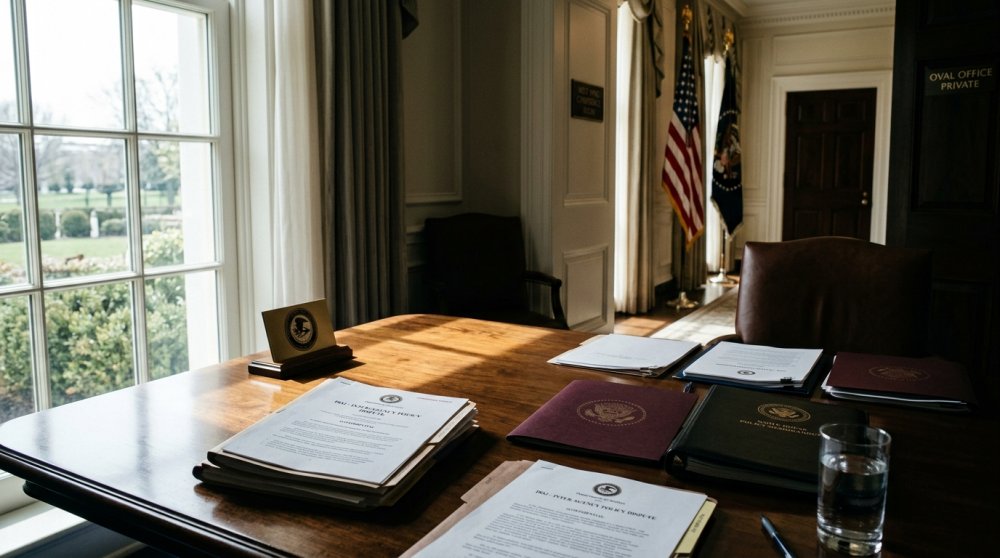
A major fracture has emerged within the Trump administration over artificial intelligence policy, as the White House directly contradicted the Justice Department’s legal stance on AI training and copyright law. The disagreement centers on whether tech companies should be allowed to use copyrighted American creative works to train their AI systems without obtaining permission or paying licensing fees.
The Justice Department recently filed a legal brief arguing for stronger copyright protections that would require AI companies to obtain rights before using protected works for training purposes. This position aligned with content creators, authors, and artists who have filed lawsuits claiming that tech giants are essentially stealing their work to build profitable AI systems.
🚨Last night, the Justice Department filed a historic statement of interest arguing that the training of AI large language models on written works does not violate copyright law under the doctrine of "fair use." @POTUS has made clear that AI dominance is critical to promote…
— Stanley E. Woodward, Jr. (@ASGWoodward) September 2, 2026
WTF
AI companies are purchasing large quantities of used and rare books. Scanning their contents to train models. Then turning the originals to pulp.
The sum of human thought, digitized and shredded.
Every book that gets scanned disappears from the physical world permanently.… pic.twitter.com/zCDV0tFaci
— Shruti (@heyshrutimishra) July 29, 2026
However, the White House quickly moved to distance itself from that position. Administration officials indicated that the DOJ brief did not reflect the president’s policy priorities on AI development and American technological competitiveness.
According to sources familiar with the matter, one senior administration official characterized the White House position as “very different than what the DOJ submitted.”
The policy clash highlights competing priorities within conservative governance: protecting property rights and supporting American creators versus ensuring the United States maintains its technological edge against foreign competitors, particularly China. Many Republicans have emphasized that overly restrictive AI regulations could hand technological supremacy to adversaries.
The AI industry has argued that training on publicly available material constitutes “fair use” under existing copyright law—a doctrine that allows limited use of copyrighted material without permission for purposes like commentary, research, and education. Tech companies contend that restricting AI training would cripple American innovation and hand the advantage to Chinese AI firms operating under fewer restrictions.
Meanwhile, creators argue that fair use was never intended to allow wholesale copying of their life’s work to build commercial products that may eventually replace them. Authors, musicians, visual artists, and other copyright holders have filed numerous lawsuits seeking compensation and control over how their work is used.
The internal administration disagreement could signal uncertainty in how federal courts will ultimately rule on these questions. Several major copyright infringement cases against AI companies are working through the legal system, and clear guidance from the executive branch could influence judicial thinking.
Some conservative legal scholars have argued that property rights—including intellectual property—should be sacrosanct, while others contend that innovation and economic growth sometimes require flexible interpretations of existing law. This debate mirrors historical conservative tensions between strict originalism and practical economic policy.
The White House has not yet issued a formal policy statement clarifying its position on AI training and copyright, leaving the matter in legal and regulatory limbo. The administration faces pressure from both Silicon Valley donors who want regulatory clarity favoring innovation and from creative industry groups seeking protection for American artists and writers.
As artificial intelligence rapidly reshapes the economy, the question of who owns the output and who should be compensated for the input remains one of the most contentious unresolved issues in American law. How the Trump administration ultimately resolves this internal split could determine whether the United States leads in AI development while protecting the rights of its creative class—or whether those goals prove incompatible.
Let us know what you think, please share your thoughts in the comments below.
